
Rapid Plume Assessment
May 13, 2026
The National Park Rapid Plume Assessment showcases the efficiency of LiORA Trends real-time modeling, utilizing 8 sensors to deliver critical insights in a fraction of the time. Get insights on your plume immediately rather than years or decades.

Executive Summary
Decades of site activities that reduced sources of hydrocarbons resulted in a complex picture of the contaminated groundwater plume. Now that immediate human and ecological health risks were addressed, the management team needed to determine if the groundwater plume was stable or if further remediation was needed to protect groundwater resources. LiORA Trends, utilizing historical sampling data, was integrated with sensor monitoring results to deliver a rapid groundwater plume stability assessment, transforming decades of uncertainty into immediate actionable intelligence. By combining traditional sampling data with real-time sensor data and advanced predictive modelling, LiORA provided critical insights for protective decision-making in a sensitive environmental setting, demonstrating how innovative technology can accelerate risk assessment while safeguarding precious natural resources.
Project Background
Site Setting and Sensitivity
A contaminated site located within a National Park presented unique environmental challenges, where the intersection of historical industrial activity and pristine natural habitat demanded exceptional care. The site's proximity to a major highway corridor highlighted the complex balance between infrastructure needs and environmental protection that characterizes many modern contamination challenges.
Contamination History
Historical underground storage tank leaks had created significant subsurface impacts, with contamination spreading through soil and groundwater systems. The age and extent of the contamination, combined with the site's sensitive location, created an urgency to understand contaminant behaviour and migration patterns.
Critical Environmental Concerns
The site's location presented multiple high-stakes risk factors:
- Surface Water Vulnerability: Proximity to surface water bodies within the National Park created immediate concern about contaminant migration and aquatic ecosystem impacts.
- Receptor Risk: The potential for human and ecological exposure in a protected natural area demanded rapid and definitive risk assessment.
- Regulatory Scrutiny: Operations within National Park boundaries required coordination with multiple regulatory agencies and adherence to the highest environmental protection standards.
Time-Critical Decision Making
Site managers needed immediate intelligence to inform protective actions and sampling strategies, but traditional assessment methods would require months to provide the temporal data necessary for confident decision-making about plume stability and migration risks.
LiORA Solution Implementation
Strategic Sensor Deployment
LiORA deployed a targeted monitoring network designed to capture critical contamination pathways:
- Groundwater Monitoring Network: Six water sensors strategically positioned to monitor subsurface contamination and potential migration toward surface water receptors.
- Soil Monitoring Array: Two soil sensors were placed to understand vadose zone conditions and potential vapor intrusion risks.
PlumeFutures Integration
LiORA's innovative LiORA Trends platform provided immediate modelling capabilities:
- Rapid Model Development: PlumeFutures generated initial contamination models immediately upon deployment, providing instant insight into plume behavior and migration potential.
- Real-Time Model Updates: Continuous sensor data feeds automatically update and refine models, improving accuracy and confidence over time.
- Predictive Analytics: Advanced modelling capabilities projected future plume behaviour under various scenarios, enabling proactive decision-making.
Accelerated Intelligence Generation
The integrated sensor-modelling approach delivered unprecedented speed in environmental assessment by providing immediate baseline understanding upon sensor deployment, continuous refinement of site conceptual models, real-time risk assessment updates, and rapid validation of protective measures.
Breakthrough Results
Immediate Plume Characterization
LiORA Trends delivered instant value by providing initial plume models that informed immediate decision-making:
- Rapid Delineation: Within weeks of sensor deployment, LiORA provided preliminary plume boundaries and migration pathways, enabling immediate protective action planning.
- Behavior Prediction: Within days, initial models projected plume stability and migration potential, allowing site managers to assess urgency and prioritize protective measures.
- Sampling Optimization: Model predictions guided 2025 sampling program design, ensuring maximum information value from traditional assessment methods.
PlumeFuture Real-Time Model Evolution
Continuous sensor data transformed initial models into increasingly sophisticated representations of site conditions:
- Dynamic Accuracy: Models continuously improved as sensor data accumulated, providing increasingly confident predictions of plume behaviour.
- Temporal Resolution: Real-time updates captured seasonal variations and short-term changes that traditional sampling would miss.
- Predictive Confidence: Extended monitoring periods validated model predictions, building confidence in long-term projections.
Seasonal Stability Validation
Comprehensive monitoring across seasonal cycles provided definitive evidence of site conditions:
- Year-Round Assessment: Continuous monitoring captured the full range of seasonal variations in contamination behavior.
- Majority Clean Confirmation: Data demonstrated that the majority of the site remained uncontaminated regardless of seasonal changes.
- Stability Verification: Evidence of plume stability across seasonal cycles provided confidence in long-term site safety.
Decision-Making Impact
Accelerated Risk Assessment
LiORA's approach compressed traditional assessment timelines from months to days:
- Immediate Intelligence: LiORA Trends and PlumeFutures provided actionable information within days rather than decades.
- Continuous Updates: Real-time data eliminated waiting periods between
Team Leads

Steven Siciliano
As CEO of LiORA, Dr. Steven Siciliano brings his experience as one of the world’s foremost soil scientists to the task of helping clients to efficiently achieve their remediation goals. Dr. Siciliano has made significant contributions to the progress of environmental and soil science with 11 book chapters and 220 scientific papers which have been cited over 17,000 times.
Discover More
The latest industry news, interviews, technologies, and resources.
Advancing Remediation Toward Closure
14 July 2026
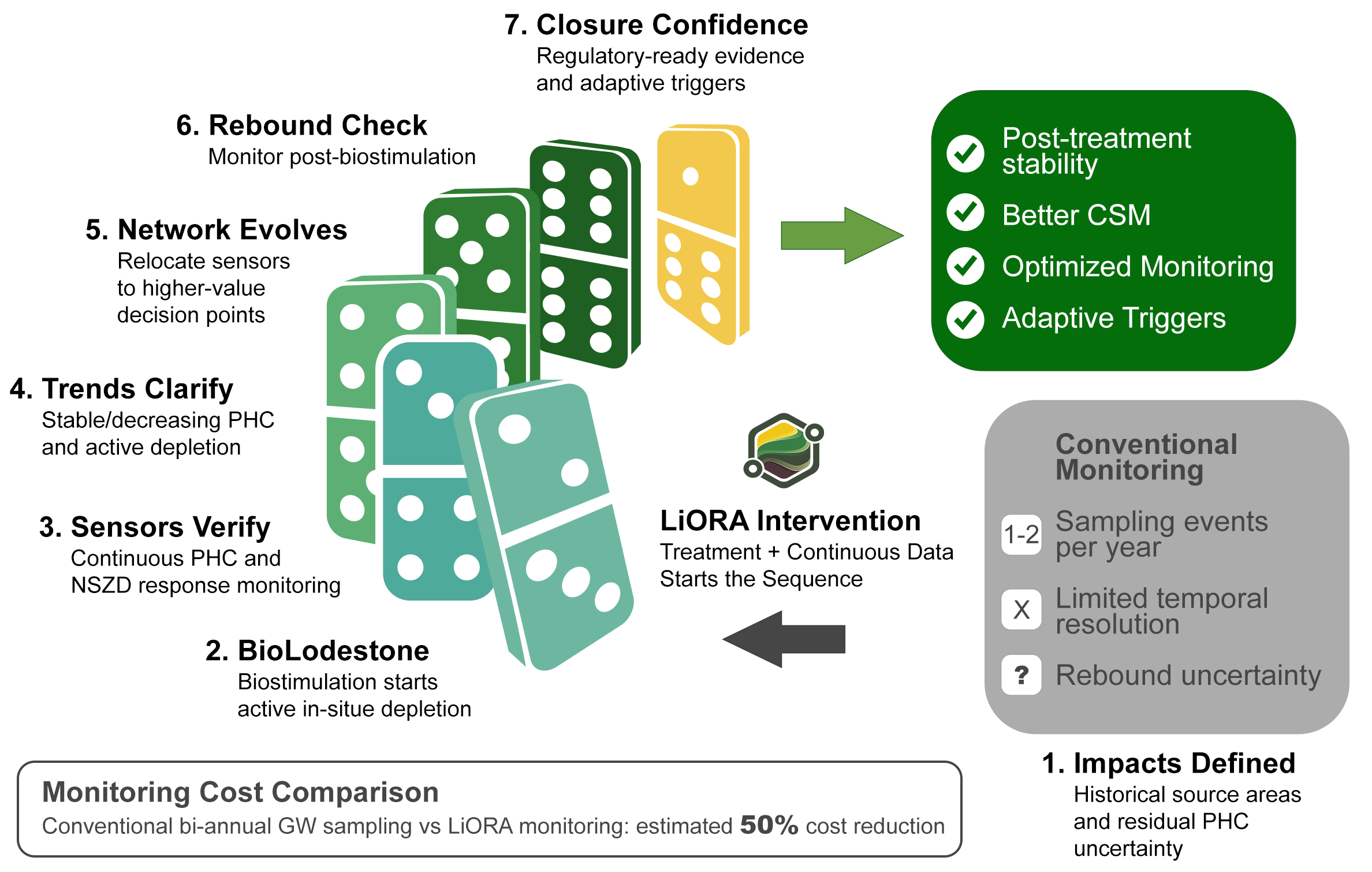
By pairing BioLodestone biostimulation with a continuous soil sensor network, we advanced a former Alberta bulk fuel site toward closure while collecting more than 175,000 data points over 20 months. The sensor record replaced conventional groundwater sampling as the primary monitoring evidence, confirming stable-to-declining PHC conditions and active depletion at roughly 50% lower annual cost than a twice-yearly sampling program.

Operational Savings in Remediation Phase
15 May 2026
Achieving $184,500 in operational savings was possible through SVE/MPE optimization and showcasing the average 14.9 kg/day depletion rate to the regulator with effective real-time monitoring.