
Optimizing Required Groundwater Sampling
July 15, 2026
For regulated petroleum sites that still owe annual or semi-annual groundwater sampling, our clients stop paying twice for the same answer. By pairing continuous monitoring with required sampling during a defined bridge period, we add the temporal context that isolated lab events miss, resolving plume stability questions in months rather than years and making each required sampling event shorter, smarter, and more defensible.

The Challenge: Data Confidence and Cost Management
For regulated petroleum sites, conventional groundwater (GW) sampling often cannot stop immediately. Annual or semi-annual sampling may still be required by regulators, consultants, or internal environmental programs even after continuous sensors are deployed. This creates a common objection:
“Why pay for sensors if we still have to pay for GW sampling?”
The concern is understandable. Conventional programs can include drilling, monitoring well installation, GW sampling, lab analysis, soil vapour assessment, reporting, and repeated review. At one regulated retail petroleum site, a conventional assessment and monitoring scope was estimated at >$80,000, including GW monitoring, soil vapour assessment, reporting, conceptual site model updates, and recommendations.
The question is not whether groundwater sampling has value. It does. The question was whether required sampling alone could provide the confidence needed to manage the site efficiently.
The Real Cost Driver: Uncertainty
Periodic sampling provides defensible laboratory data, but it captures site conditions only at discrete points in time. At complex petroleum sites, concentrations can vary because of groundwater fluctuations, seasonal effects, LNAPL behaviour, source depletion, vapour transport, and natural attenuation processes.
When site behaviour remains uncertain, conventional programs can continue for years as project teams repeatedly ask the same questions:
- Are impacts stable?
- Are risks changing?
- Is the plume expanding or seasonal?
- Can the monitoring program be optimized without reducing confidence?
LiORA’s Role: A Bridge to Smarter Sampling
LiORA sensors were incorporated into the existing monitoring program rather than positioned as a groundwater sampling replacement. Targeted soil and groundwater sensors were deployed to strengthen interpretation across key parts of the plume, including background, source-area, plume-core, and plume-boundary conditions.
The value was not duplication. The value was context.
Required sampling continued to provide regulator-recognized laboratory data, compliance evidence, and point-in-time chemistry. Continuous monitoring added the missing temporal context: conditions between sampling events, seasonal and short-term variability, trend direction, plume behaviour, and better confidence around timing, scope, and decision-making.
This made each required sampling event more useful by helping determine whether a result was representative, seasonal, anomalous, or part of a larger site trend.
Why the Bridge Period Matters
For clients who must continue annual GW, PHC, or chloride sampling, LiORA can structure the first 1–3 years as a regulatory bridge period. During this period, conventional sampling continues, but the client is not paying twice for the same answer. The combined program is designed to maintain compliance while building the continuous evidence needed to optimize sampling frequency, locations, analyte lists, and long-term site-management decisions.
This approach aligns with monitoring-frequency research presented in LiORA’s technical materials: annual sampling may require approximately six years and about $60k to estimate plume stability, while high-frequency monitoring can resolve stability questions in months at approximately $20k–$40k.
Outcome
At the site level, LiORA helps clients avoid paying indefinitely for uncertainty. At the portfolio level, it helps teams prioritize resources based on measured site behaviour rather than isolated sampling events.
The result is a more efficient path from required monitoring to defensible management decisions: fewer ambiguous results, better-timed field programs, clearer regulator-facing evidence, and a stronger basis for optimizing conventional sampling over time.
Key Takeaway
LiORA does not need to replace required groundwater sampling on day one to create value. Its role is to make the required sampling period shorter, smarter, and more defensible by pairing continuous monitoring with conventional sampling during a defined bridge period.

Team Leads

Steven Siciliano
As CEO of LiORA, Dr. Steven Siciliano brings his experience as one of the world’s foremost soil scientists to the task of helping clients to efficiently achieve their remediation goals. Dr. Siciliano has made significant contributions to the progress of environmental and soil science with 11 book chapters and 220 scientific papers which have been cited over 17,000 times.
Discover More
The latest industry news, interviews, technologies, and resources.
Advancing Remediation Toward Closure
14 July 2026
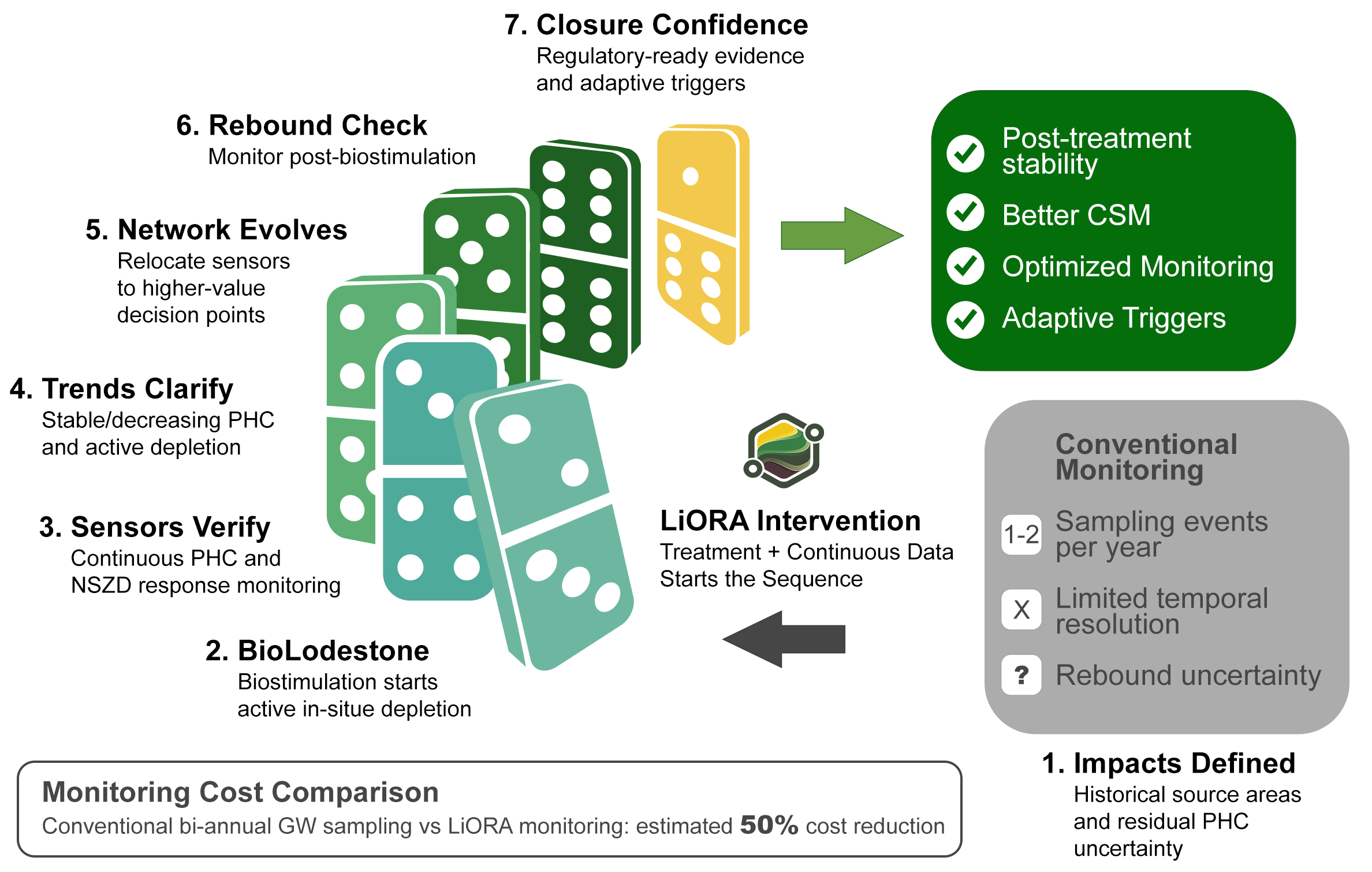
By pairing BioLodestone biostimulation with a continuous soil sensor network, we advanced a former Alberta bulk fuel site toward closure while collecting more than 175,000 data points over 20 months. The sensor record replaced conventional groundwater sampling as the primary monitoring evidence, confirming stable-to-declining PHC conditions and active depletion at roughly 50% lower annual cost than a twice-yearly sampling program.

Operational Savings in Remediation Phase
15 May 2026
Achieving $184,500 in operational savings was possible through SVE/MPE optimization and showcasing the average 14.9 kg/day depletion rate to the regulator with effective real-time monitoring.