
Advancing Remediation Toward Closure
July 14, 2026
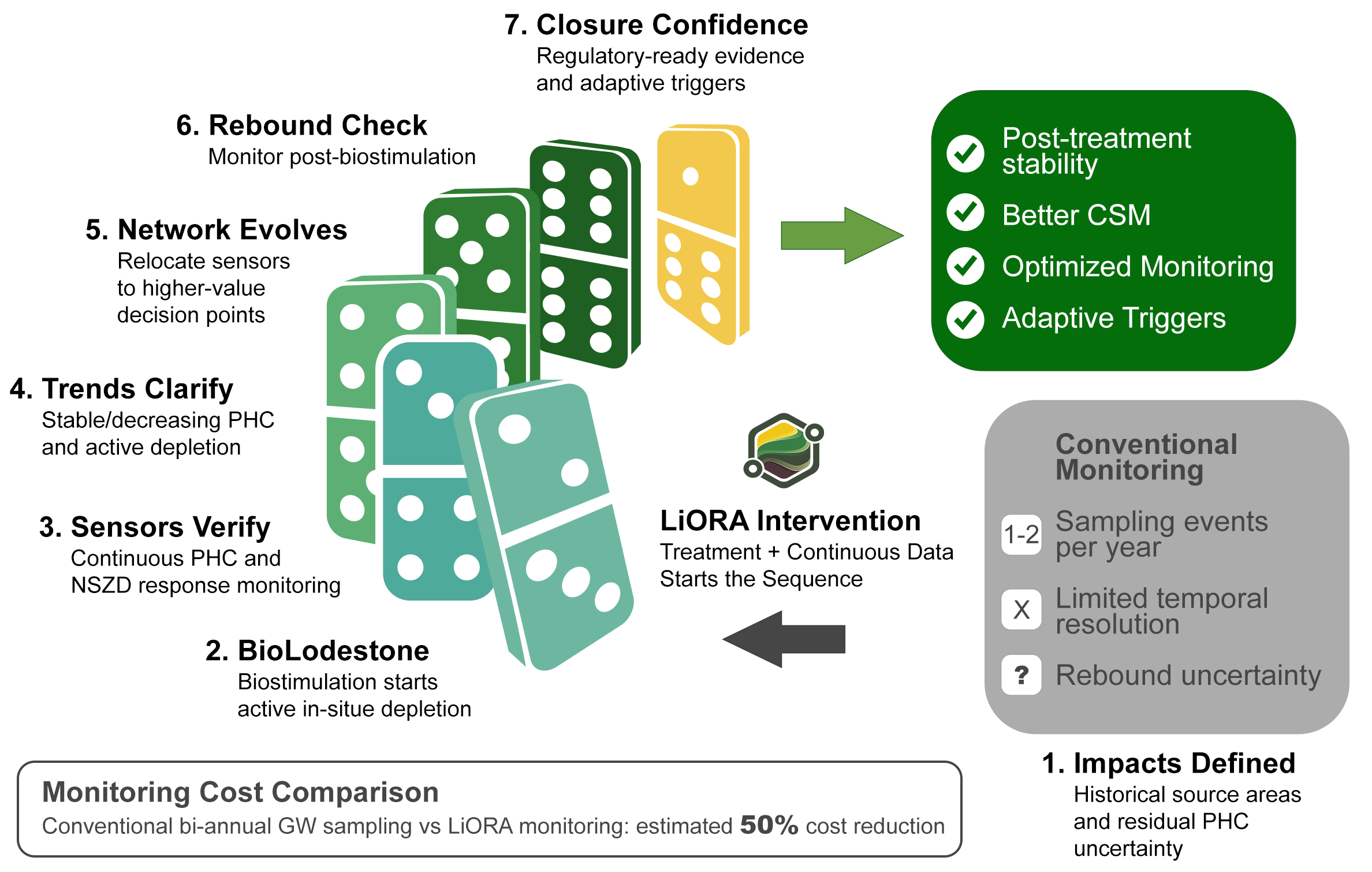
By pairing BioLodestone biostimulation with a continuous soil sensor network, we advanced a former Alberta bulk fuel site toward closure while collecting more than 175,000 data points over 20 months. The sensor record replaced conventional groundwater sampling as the primary monitoring evidence, confirming stable-to-declining PHC conditions and active depletion at roughly 50% lower annual cost than a twice-yearly sampling program.
The Remediation Challenge
At petroleum hydrocarbon-impacted sites, active remediation is only one part of the pathway to closure. Project teams also need to demonstrate that treatment is working, residual impacts are stable or declining, and monitoring remains focused on the locations that matter most.
At a former bulk fuel site in Alberta, a shallow soil investigation identified PHC impacts in the upper 3 m, concentrated in two historical source areas associated with former site infrastructure.
The project team needed a practical way to support active remediation while building the evidence required for closure planning: confirming that impacts were stabilizing, depletion processes remained active, and future monitoring could focus where it would most reduce uncertainty.
Where Conventional Monitoring Left Uncertainty
Traditional soil and groundwater sampling provides valuable information, but periodic sampling leaves large gaps in time. At a site undergoing biostimulation, those gaps make it difficult to distinguish remediation progress from seasonal variation, short-term variability, or rebound after treatment stops.
The consultant’s 2023 monitoring event followed a biennial monitoring schedule. That event monitored eight on-site and one off-site wells, but groundwater samples were collected from only three on-site wells and one off-site well. Since then, the project team has relied on LiORA’s continuous monitoring to evaluate remediation performance and guide the next phase of site management.
That reliance is significant. On this site, LiORA’s reports were not simply used as an appendix to conventional monitoring. They became the primary monitoring record for understanding whether remediation was working and where the monitoring program should go next. The key questions were:
- Are PHC concentrations declining or stabilizing during treatment?
- Are natural source zone depletion processes active?
- Which locations still require monitoring, and which are no longer decision-critical?
- Can the monitoring network be adjusted as site conditions improve?
- Can post-treatment monitoring support confidence that rebound is not occurring?
LiORA’s Role
LiORA deployed an integrated treatment and monitoring program: BioLodestone, LiORA’s site-specific biostimulatory amendment, was applied to stimulate in-situ PHC degradation, while a soil sensor network installed in existing wells continuously tracked plume behaviour and NSZD through time. The objective was to understand plume dynamics and remedial effectiveness during the bioremediation program.
Over 20 months, the sensor network had collected more than 175,000 data points. Those data indicated low and stable-to-declining PHC conditions, with remaining impacts localized near historical source areas.
The sensors also provided a continuous NSZD signal. NSZD rates remained consistent with expected performance for the site’s plume characteristics, and the gradual decline in NSZD through time was interpreted as consistent with progressive PHC mass consumption rather than reduced remedial performance.
Outcome: Cost-Competitive Monitoring With Continuous Evidence
LiORA helped the project team move from active treatment toward closure-focused monitoring. The value was not simply more data; it was confidence. Continuous monitoring provided enough evidence for the consultant and client to rely on the sensor record in place of a conventional groundwater sampling program while assessing remedial performance and planning the next phase of work. The continuous monitoring record supported:
- Demonstration of stable-to-declining PHC conditions.
- Evidence that depletion processes remained active during treatment.
- Identification of residual impacts localized near historical source areas.
- Confidence that most monitored locations were low or near detection limits.
- Relocation of sensors from low-response locations to more decision-critical areas.
- Post-treatment monitoring to assess rebound and support future regulatory discussions.
The monitoring approach was also cost-competitive with conventional sampling. Compared to an estimated twice-yearly groundwater sampling program involving repeated mobilization, groundwater gauging and sampling, laboratory analysis, data review, and consultant reporting, LiORA’s monitoring cost was estimated to be ~50% less per year, while providing continuous trend evidence rather than two discrete sampling events.
Key Takeaway
LiORA’s integrated BioLodestone and sensor program helped advance a former bulk fuel site along the pathway to closure by combining active biostimulation with continuous performance monitoring. As the site transitions out of active treatment, the same sensor network can be redeployed to higher-value locations, supporting post-treatment confirmation, adaptive management, and regulatory decision-making at a monitoring cost that is competitive with conventional biannual groundwater sampling.

Team Leads

Steven Siciliano
As CEO of LiORA, Dr. Steven Siciliano brings his experience as one of the world’s foremost soil scientists to the task of helping clients to efficiently achieve their remediation goals. Dr. Siciliano has made significant contributions to the progress of environmental and soil science with 11 book chapters and 220 scientific papers which have been cited over 17,000 times.
Discover More
The latest industry news, interviews, technologies, and resources.
Advancing Remediation Toward Closure
14 July 2026
By pairing BioLodestone biostimulation with a continuous soil sensor network, we advanced a former Alberta bulk fuel site toward closure while collecting more than 175,000 data points over 20 months. The sensor record replaced conventional groundwater sampling as the primary monitoring evidence, confirming stable-to-declining PHC conditions and active depletion at roughly 50% lower annual cost than a twice-yearly sampling program.

Operational Savings in Remediation Phase
15 May 2026
Achieving $184,500 in operational savings was possible through SVE/MPE optimization and showcasing the average 14.9 kg/day depletion rate to the regulator with effective real-time monitoring.