
Cost Savings of NSZD Monitoring
May 13, 2026
Achieved significant savings through innovative data collection and depletion rate monitoring with advanced sensor technology and real-time analytics. The project resulted in $748,680 in savings through the deployment of 17 sensors, collecting 23 million data points to monitor a 4,490 L/year depletion rate.

Executive Summary
LiORA's innovative technology successfully guided the remediation strategy at a former bulk fuel facility, enabling a precise Natural Source Zone Depletion (NSZD) assessment that reduced the excavation area and optimized site management. Through continuous monitoring and data-driven analysis, LiORA demonstrated how advanced sensor technology can transform traditional remediation approaches from broad-scale excavation to targeted, efficient interventions.
Project Background
Site Overview
A former bulk fuel facility presented complex environmental challenges stemming from decades of historical operations and deteriorating underground infrastructure. The site's legacy of petroleum hydrocarbon contamination required careful assessment to determine the most effective remediation approach.
Historical Context
Environmental investigations spanning nearly two decades (2002-2019) had documented extensive petroleum hydrocarbon (PHC) impacts across the site, including the presence of Light Non-Aqueous Phase Liquid (LNAPL). Traditional assessment methods provided snapshots of contamination but lacked the continuous monitoring capability needed to understand dynamic subsurface processes.
The Challenge
Site managers faced a critical decision: proceed with extensive excavation based on historical data, or invest in advanced monitoring to better understand natural attenuation processes. The potential for unnecessary soil removal, associated costs, and environmental disruption made this decision particularly significant.
LiORA Solution Implementation
Technology Deployment
LiORA deployed five strategically positioned sensors across the impacted area. These advanced sensors provided continuous, real-time monitoring of subsurface conditions, offering unprecedented insight into contamination behavior and natural attenuation processes.
Monitoring Strategy
The sensor network was designed to capture spatial and temporal variations in contaminant concentrations, monitor environmental parameters affecting NSZD rates, provide continuous data streams for comprehensive analysis, and enable remote monitoring and real-time decision support.
Data Collection Period
A comprehensive 12-month monitoring period ensured capture of seasonal variations and long-term trends, providing robust data for NSZD assessment and remediation planning.
Key Findings
LiORA's continuous monitoring revealed that Natural Source Zone Depletion was not occurring at significant rates within the affected areas. This critical finding indicated that natural attenuation alone would not achieve remediation objectives within acceptable timeframes.
The sensor data provided a detailed mapping of contamination patterns, revealing areas where contaminant concentrations remained stable or increased, zones with minimal natural attenuation activity, and precise boundaries of active contamination that required intervention.
Continuous monitoring data enabled LiORA to quantify actual NSZD rates versus theoretical predictions, identify environmental factors that limit natural attenuation, and provide evidence- based recommendations for a remediation strategy.
Impact and Results
Remediation Optimization
LiORA's NSZD assessment fundamentally transformed the remediation approach:
- Targeted Excavation: Instead of broad-scale soil removal based on historical data, the continuous monitoring data enabled a precise definition of areas requiring active remediation.
- Reduced Environmental Impact: By accurately mapping contamination boundaries and natural attenuation zones, LiORA minimized unnecessary excavation and associated environmental disturbance.
- Cost Efficiency: Targeted remediation reduced material handling, disposal costs, and site restoration requirements while maintaining remediation effectiveness.
Quantifiable Benefits
The benefits of this approach include reduced excavation area through precise contamination mapping, minimized soil disposal volumes by avoiding unnecessary removal, accelerated project timeline through real-time decision support, and enhanced remediation confidence through continuous verification.
Technical Innovation
LiORA's Soil Sensors represent a significant advancement in environmental monitoring by offering continuous, autonomous operation with multi-parameter monitoring capabilities, real-time data transmission and analysis, and long-term reliability despite subsurface conditions.
LiORA's sophisticated Dashboards and Data Analysis capabilities transformed raw sensor data into actionable insights with advanced statistical analysis of contamination trends, predictive modeling of natural attenuation processes, spatial interpolation, contamination mapping and integration with traditional assessment data.
Paradigm Shift in Remediation
This case study demonstrates a fundamental shift from reactive to proactive remediation management. Traditional approaches rely on periodic sampling and broad assumptions about contamination behavior. LiORA's continuous monitoring enables dynamic, evidence-based decision-making throughout the remediation process.
Regulatory Acceptance
The robust data generated by LiORA's monitoring system supports regulatory compliance and provides compelling evidence for remediation decisions. Continuous monitoring data offers regulatory agencies unprecedented visibility into site conditions and remediation progress.
Sustainability Benefits
By optimizing remediation scope and reducing unnecessary excavation, LiORA's approach delivers significant sustainability benefits of reduced carbon footprint from material transport/disposal, minimized ecosystem disruption, decreased energy consumption and enhanced long-term site stewardship.
Lessons Learned
Value of Continuous Monitoring
This project conclusively demonstrated that continuous monitoring provides insights unavailable through traditional assessment methods. The ability to observe contamination behavior over time revealed that assumptions about natural attenuation were not valid for this site.
Technology Integration
Successful implementation required careful integration of advanced sensor technology with traditional assessment methods. LiORA's approach complemented rather than replaced conventional techniques, creating a more comprehensive understanding of site conditions.
Stakeholder Engagement
Early engagement with regulatory agencies and stakeholders regarding monitoring objectives and data interpretation proved crucial for project success.
Future Applications
The success of this project demonstrates LiORA's technology scalability across various contaminated sites. The modular sensor deployment and flexible monitoring strategies can be adapted to diverse site conditions and contamination scenarios.
Ongoing technology development promises even greater capabilities of enhanced sensor sensitivity, additional parameter range, advanced predictive analytics with machine learning, integration with emerging remediation technologies and expanded real-time decision support tools
Conclusion
LiORA's NSZD assessment at the former bulk fuel facility exemplifies how advanced monitoring technology can revolutionize environmental remediation. By providing continuous, accurate data on subsurface conditions, LiORA enabled targeted, efficient remediation that minimized environmental impact while achieving cleanup objectives.
This case study establishes LiORA as a leader in smart environmental monitoring, demonstrating measurable value through reduced excavation areas, optimized remediation strategies, and enhanced sustainability. The project's success validates LiORA's vision of data-driven environmental management, positioning the company for continued growth in the evolving remediation industry.
The integration of advanced sensor technology with sophisticated data analytics represents the future of environmental remediation – one where decisions are based on real-time evidence rather than historical assumptions, leading to more effective, efficient, and sustainable cleanup solutions.
Team Leads

Steven Siciliano
As CEO of LiORA, Dr. Steven Siciliano brings his experience as one of the world’s foremost soil scientists to the task of helping clients to efficiently achieve their remediation goals. Dr. Siciliano has made significant contributions to the progress of environmental and soil science with 11 book chapters and 220 scientific papers which have been cited over 17,000 times.
Discover More
The latest industry news, interviews, technologies, and resources.
Advancing Remediation Toward Closure
14 July 2026
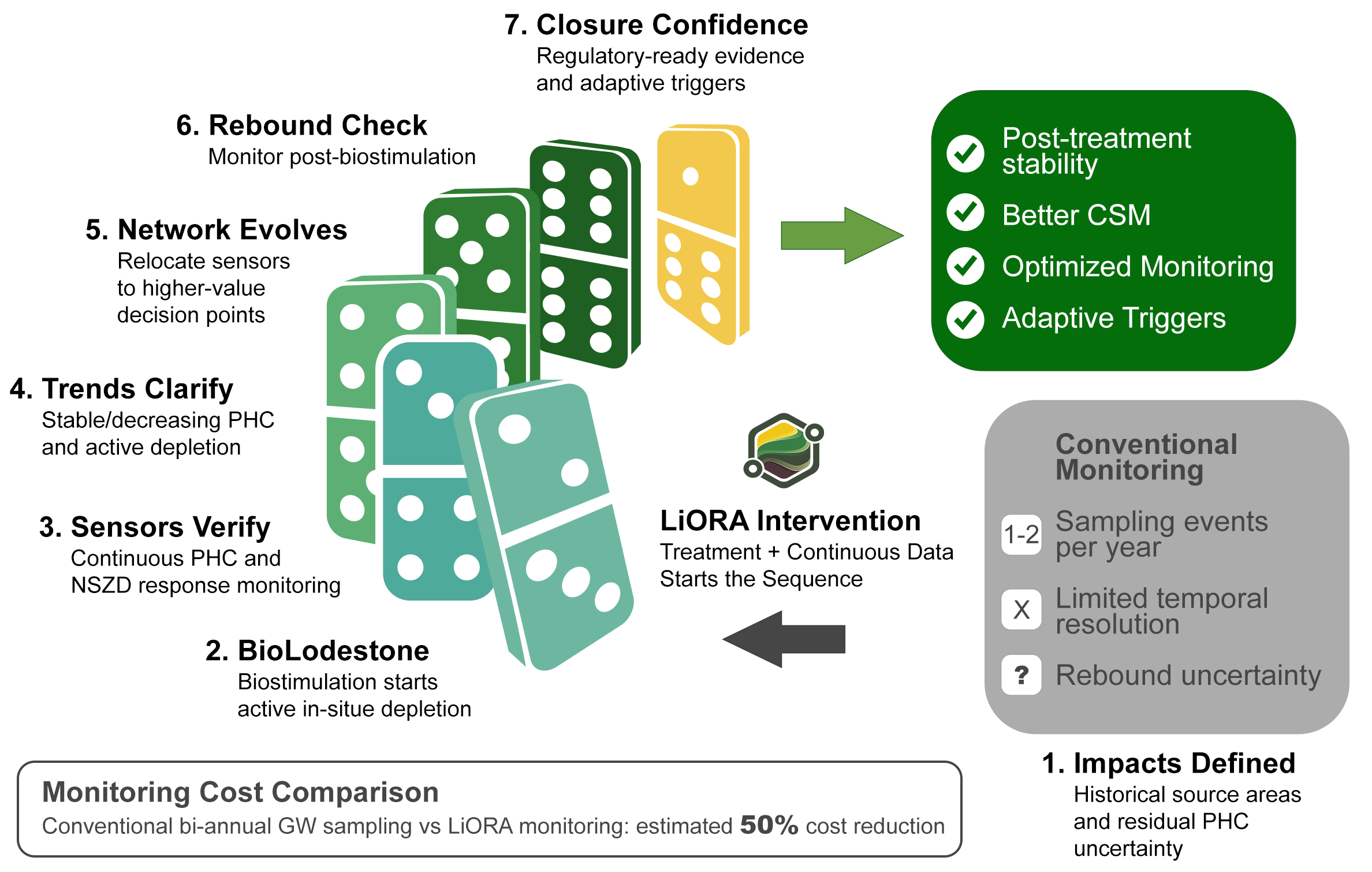
By pairing BioLodestone biostimulation with a continuous soil sensor network, we advanced a former Alberta bulk fuel site toward closure while collecting more than 175,000 data points over 20 months. The sensor record replaced conventional groundwater sampling as the primary monitoring evidence, confirming stable-to-declining PHC conditions and active depletion at roughly 50% lower annual cost than a twice-yearly sampling program.

Operational Savings in Remediation Phase
15 May 2026
Achieving $184,500 in operational savings was possible through SVE/MPE optimization and showcasing the average 14.9 kg/day depletion rate to the regulator with effective real-time monitoring.