
Operational Savings in Remediation Phase
May 15, 2026
Achieving $184,500 in operational savings was possible through SVE/MPE optimization and showcasing the average 14.9 kg/day depletion rate to the regulator with effective real-time monitoring.

Executive Summary
LiORA's real-time soil sensor network successfully optimized SVE/MPE remediation system performance at a pipeline condensate release site, delivering $184,500 in operational cost savings while achieving significant environmental benefits. Through continuous monitoring of remedial progress, LiORA enabled data-driven system optimization, reducing operating costs by identifying optimal shutdown periods and enhancing system efficiency. The project demonstrated substantial ROI through avoided excavation costs and environmental impact reduction.
Project Background
Pipeline Release Incident
A pipeline failure resulted in approximately 20 cubic meters of condensate being released into the subsurface, creating significant environmental contamination that required immediate remedial action.
Contamination Scope
The release created substantial subsurface impacts:
- Initial Plume Area: 2,195 m²
- Original Impacted Soil Volume: 4,254 m³
- Contaminant Type: Condensate with benzene and associated hydrocarbons
Remediation Strategy
Site managers selected an integrated SVE/MPE (Soil Vapor Extraction/Multi-Phase Extraction) system to recover LNAPL and remediate subsurface contamination. The approach required optimization to maximize efficiency while minimizing operational costs.
LiORA Solution
Real-Time Monitoring Network
LiORA deployed a comprehensive soil sensor network designed to monitor remedial progress in real-ime:
- Soil Sensor Array: Strategic placement of sensors throughout the contaminated area to track depletion rates and system performance.
- Continuous Operation: 24/7 monitoring provided continuous assessment of remediation effectiveness and system optimization opportunities.
- Performance Tracking: Real-time data enabled immediate assessment of system efficiency and identification of marginal return periods.
Data-Driven Optimization
LiORA's monitoring approach enabled sophisticated system optimization through real-time depletion rate calculations, system efficiency assessment, identification of optimal operational periods, and cost-benefit analysis for system operations.
Breakthrough Results
Quantified Remediation Performance
LiORA's monitoring system provided precise measurement of remedial effectiveness:
- Mean Depletion Rate: 14.9 kg/day (benzene equivalents) - providing a quantitative assessment of system performance.
- Performance Trending: Continuous monitoring revealed when the SVE/MPE system reached marginal returns, enabling optimal operational decisions.
- System Efficiency Mapping: Real-time data showed periods of above and below mean standardized depletion rates, enabling targeted system optimization.
Operational Cost Savings
Data-driven system optimization delivered substantial cost reductions:
- Operating Cost Reduction: $84,500 in operational savings through optimized system runtime.
- Diesel Cost Savings: $100,000 in fuel cost reduction by identifying optimal shutdown periods.
- Total Direct Savings: $184,500 in immediate operational cost reductions.
Environmental Impact Reduction
LiORA's optimization approach delivered significant environmental benefits compared to traditional excavation:
- Financial Savings: $98,400 avoided through optimized in-situ remediation versus excavation.
- Soil Preservation: 820 m³ of soil left in place rather than excavated and disposed.
- Water Conservation: 155,800 kg of water saved through avoided excavation and treatment.
- Carbon Footprint Reduction: 99,220 kg of CO2-equivalents avoided through optimized remediation approach.
Technical Innovation
Real-Time Performance Assessment
LiORA's monitoring system provided unprecedented visibility into remediation system performance:
- Continuous Depletion Tracking: Real-time calculation of contaminant removal rates enabled immediate system assessment.
- Performance Benchmarking: Comparison of actual performance against standardized NSZD rates provided context for system efficiency.
- Optimization Identification: Data analytics identified periods of diminishing returns, enabling operational adjustments.
System Efficiency Optimization
Advanced analytics transformed raw monitoring data into actionable operational intelligence:
- Marginal Return Analysis: Identification of when system effectiveness declined below cost-ffective thresholds.
- Operational Scheduling: Data-driven recommendations for optimal system operation and shutdown periods.
- Cost-Benefit Integration: Real-time cost-effectiveness calculations supporting operational decisions.
Economic Impact Analysis
Direct Cost Savings
LiORA's monitoring system delivered immediate operational benefits:
- Operational Efficiency: $84,500 reduction in operating costs through optimized system runtime.
- Fuel Savings: $100,000 in diesel cost reduction through strategic system shutdowns.
- Total Operational Savings: $184,500 in direct cost reductions over the monitoring period.
Avoided Excavation Benefits
In-situ remediation optimization provided substantial benefits compared to excavation alternatives:
- Capital Cost Avoidance: $98,400 in avoided excavation and disposal costs.
- Resource Conservation: Significant environmental benefits through reduced material handling and disposal.
- Operational Efficiency: Faster remediation timeline compared to excavation approaches.
Return on Investment
The project demonstrated exceptional ROI through direct operational cost savings, avoidance of excavation expenses, environmental impact reduction, accelerated remediation timeline and enhanced system performance.
Environmental Benefits
LiORA's approach delivered significant sustainability advantages:
- Reduced Material Handling: 820 m³ of soil left in place rather than excavated and disposed.
- Water Conservation: 155,800 kg of water saved through optimized in-situ approach.
- Carbon Footprint Reduction: 99,220 kg of CO2-equivalents avoided through efficient remediation.
Ecosystem Protection
In-situ optimization minimized environmental disturbance, reduced surface disruption, minimized transportation impacts, preserved soil structure, improved ecosystem function, and reduced waste generation.
Future Applications
The successful approach applies to numerous pipeline release scenarios requiring SVE/MPE remediation.
LiORA's monitoring approach can be adapted to other in-situ remediation technologies requiring performance optimization.
Project success supports broader adoption of real-time monitoring for remediation system optimization.
Conclusion
LiORA's real-time monitoring of SVE/MPE remediation at this pipeline release site delivered exceptional value through operational cost savings, reduced environmental impact, and enhanced remediation effectiveness. The project's $184,500 in direct operational savings, combined with $98,400 in avoided excavation costs and significant environmental benefits, demonstrates the transformative potential of continuous remediation monitoring.
The ability to identify optimal system operation periods and marginal return thresholds through real- time depletion rate monitoring represents a breakthrough in remediation system optimization. LiORA's approach transformed traditional "set and forget" remediation into dynamic, data-driven system management that maximizes efficiency while minimizing costs.
This project establishes LiORA as the definitive leader in real-time remediation monitoring, providing midstream clients and their consultants with the intelligence necessary to optimize system performance, reduce operational costs, and achieve superior environmental outcomes. The quantified benefits demonstrate clear ROI and position LiORA for expanded adoption across the pipeline and remediation industries.
Team Leads

Steven Siciliano
As CEO of LiORA, Dr. Steven Siciliano brings his experience as one of the world’s foremost soil scientists to the task of helping clients to efficiently achieve their remediation goals. Dr. Siciliano has made significant contributions to the progress of environmental and soil science with 11 book chapters and 220 scientific papers which have been cited over 17,000 times.
Discover More
The latest industry news, interviews, technologies, and resources.
Advancing Remediation Toward Closure
14 July 2026
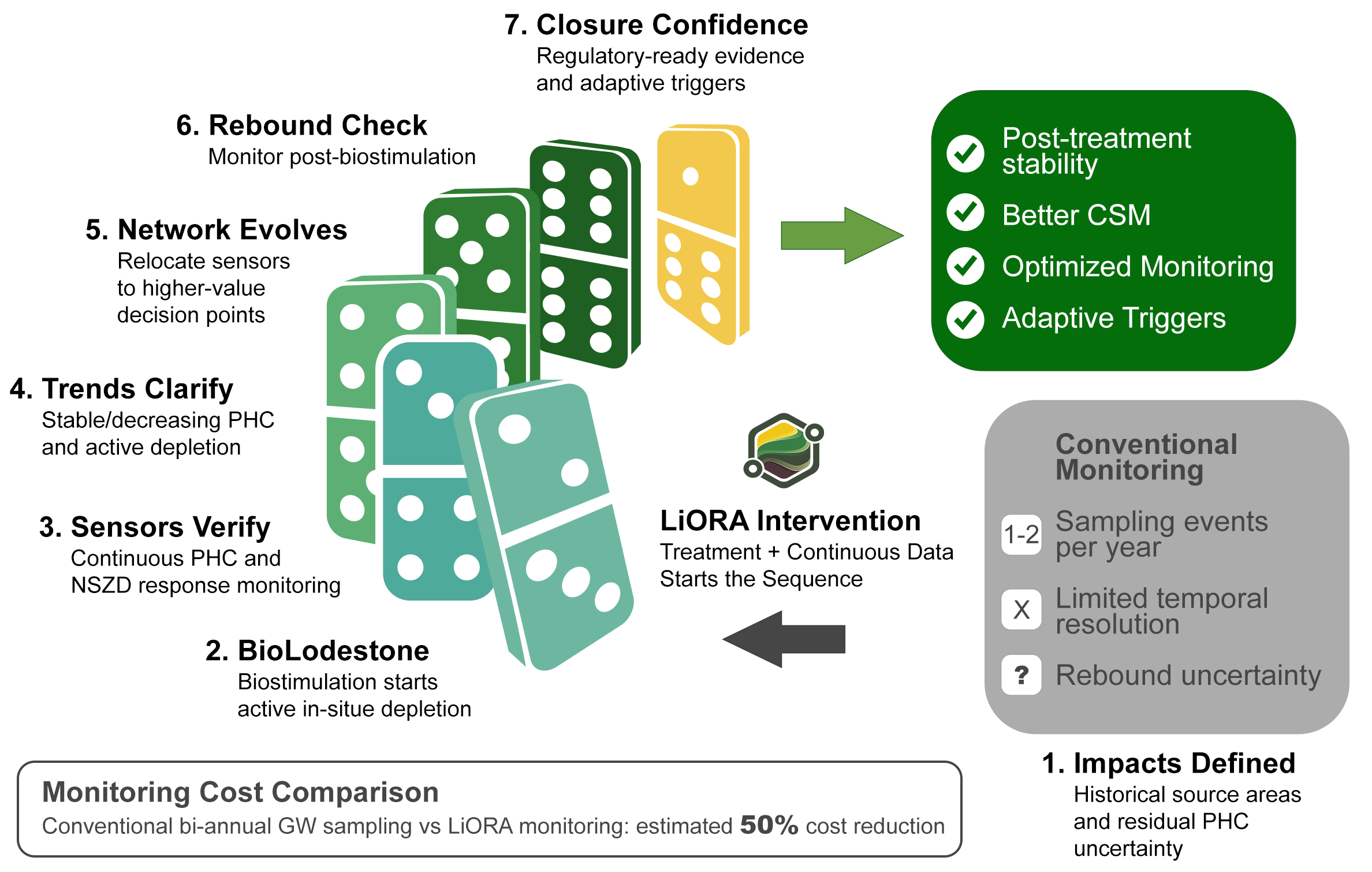
By pairing BioLodestone biostimulation with a continuous soil sensor network, we advanced a former Alberta bulk fuel site toward closure while collecting more than 175,000 data points over 20 months. The sensor record replaced conventional groundwater sampling as the primary monitoring evidence, confirming stable-to-declining PHC conditions and active depletion at roughly 50% lower annual cost than a twice-yearly sampling program.
Operational Savings in Remediation Phase
15 May 2026
Achieving $184,500 in operational savings was possible through SVE/MPE optimization and showcasing the average 14.9 kg/day depletion rate to the regulator with effective real-time monitoring.