
Midstream Spill Site Depletion Monitoring
May 13, 2026
Our data better informs resource allocation through access to live data. Our clients unlock more effective site prioritization by highlighting risk in realtime and insitu remediation system success with only six sensors per site to deliver results to allow our clients to move onto other priority sites.
Executive Summary
LiORA's comprehensive sensor network successfully demonstrated the effectiveness of natural attenuation at a large midstream crude oil and condensate facility, providing regulators with definitive evidence of plume stability and depletion. Through the deployment of 17 sensors, LiORA collected over 23 million data points in one year, quantifying an annual depletion rate of 4,490 L/year (benzene equivalents) and confirming the stability of the LNAPL plume. The project delivered $748,680 in cost savings compared to excavation, while eliminating safety hazards and environmental impacts associated with traditional sampling methods.
Project Background
Site Overview
A midstream facility for storage and distribution of crude oil and natural gas condensate required a comprehensive assessment of natural attenuation processes following numerous historical spills.
Contamination Scope
- Multiple crude oil and condensate spills over the operational history
- Primary contaminants: benzene and light-end hydrocarbons
- Dissolved benzene covering approximately 25,000 m²
- Initial plume area: 19,844 m²
- Original impacted soil volume: 26,924 m³
Regulatory Objectives
- Characterize degradation rates and plume dynamics
- Track plume stability and persistence for regulatory reporting
- Collect 365 days of baseline data demonstrating natural depletion
- Reduce safety hazards and environmental impacts of traditional sampling
LiORA Solution
Comprehensive Sensor Network
LiORA deployed 17 Soil Sensors with the following strategic placements:
- 1 Background sensor for reference conditions
- 6 In-plume sensors for source zone monitoring
- 10 Plume fringe sensors for migration assessment
- Sensors installed at 1.5, 2, and 2.5 meters below ground surface
Data Collection Strategy
The monitoring network provided unprecedented temporal resolution:
- 365 days of continuous monitoring
- Over 23 million data points collected
- Real-time assessment of natural attenuation processes
- Comprehensive plume behavior characterization
Key Results
Quantified Natural Attenuation
LiORA's monitoring system provided definitive evidence of natural depletion:
- Annual Depletion Rate: 4,490 L/year (benzene equivalents) - providing quantitative evidence of natural attenuation effectiveness.
- Plume Stability Confirmation: Data demonstrated LNAPL plume stability with decreasing contaminant volume over time.
- Mass Removal Quantification: Precise calculation of natural mass removal rates and projected timeframes for continued depletion.
Regulatory Evidence Package
Comprehensive monitoring data provided robust regulatory support:
- Baseline Data: Complete 365-day dataset establishing natural attenuation baseline conditions.
- Degradation Rate Characterization: Quantified natural degradation processes occurring at the site.
- Plume Dynamics: Detailed understanding of plume behavior and migration patterns.
Net Benefits
Cost Savings Analysis
LiORA's approach delivered significant economic advantages compared to excavation:
- Soil Conservation: 6,239 m³ of soil preserved through natural attenuation approach.
- Cost Reduction: $748,680 in avoided excavation and disposal costs.
- Carbon Footprint Reduction: 754,919 kg of CO₂-equivalents avoided through optimized remediation strategy.
Operational Benefits
Continuous monitoring eliminated traditional sampling challenges:
- Safety Improvement: Reduced personnel exposure to hazardous materials and confined spaces.
- Environmental Impact: Eliminated carbon footprint and waste associated with frequent sampling activities.
- Operational Efficiency: Continuous monitoring reduced disruption to facility operations.
Technical Innovation
Unprecedented Data Resolution
LiORA's monitoring system provided superior data quality:
- Temporal Resolution: Over 23 million data points provided unprecedented understanding of natural attenuation processes.
- Spatial Coverage: 17 sensors across plume zones provided comprehensive spatial assessment.
- Real-Time Analytics: Continuous data processing enabled immediate assessment of natural attenuation effectiveness.
Performance Benchmarking
Advanced analytics provided sophisticated performance assessment:
- Standardized NSZD Rates: Comparison of site performance against established natural attenuation benchmarks.
- Seasonal Variations: Identification of periods with above and below mean natural attenuation rates.
- Predictive Modeling: Historical data supporting projections of future natural attenuation performance.
Strategic Impact
Regulatory Confidence
Comprehensive monitoring data provided regulators with confidence in natural attenuation approach:
- Scientific Evidence: Robust dataset supporting natural attenuation effectiveness.
- Transparency: Continuous monitoring enabled transparent regulatory reporting.
- Risk Assessment: Quantified depletion rates supporting risk-based management decisions.
Facility Management
Enhanced environmental management capabilities:
- Proactive Monitoring: Real-time data enabling immediate response to changing conditions.
- Liability Management: Quantified environmental and financial liability through precise mass calculations.
- Operational Integration: Monitoring system integrated with facility environmental management systems.
Future Applications
Enhanced Remediation Strategy
Monitoring insights support optimized remediation planning:
- Active Technique Integration: Data-driven selection of active techniques to increase degradation rates where beneficial.
- Timeline Optimization: Precise mass removal rate calculations supporting remediation timeline development.
- Cost-Benefit Analysis: Comprehensive data supporting decisions between active and passive remediation approaches.
Regulatory Framework
Project success supports broader adoption of natural attenuation monitoring:
- Best Practice Development: Comprehensive monitoring approach establishing industry standards.
- Regulatory Acceptance: Demonstrated effectiveness supporting regulatory approval for similar approaches.
- Technology Validation: Successful deployment validating sensor-based natural attenuation assessment.
Lessons Learned
Large-scale contamination requires extensive sensor networks to provide adequate spatial and temporal coverage for regulatory confidence.
High-resolution monitoring data provides the scientific foundation necessary for regulatory acceptance of natural attenuation approaches.
Quantified economic and environmental benefits provide compelling business case for natural attenuation monitoring.
Conclusion
LiORA's comprehensive monitoring at this midstream facility successfully demonstrated the effectiveness of natural attenuation at scale, providing regulators with definitive evidence of plume stability and quantified depletion rates. The project's collection of over 23 million data points over 365 days established an unprecedented baseline for assessing natural attenuation.
The quantified annual depletion rate of 4,490 L/year (benzene equivalents) provides regulators with the scientific evidence necessary to support natural attenuation as a viable remediation strategy. Combined with $748,680 in cost savings and substantial environmental benefits, the project demonstrates the value of continuous monitoring for large-scale contamination management.
This case study establishes LiORA as the definitive solution for natural attenuation assessment at complex industrial sites, providing the data quality and regulatory confidence necessary for successful risk-based management approaches.
Team Leads

Steven Siciliano
As CEO of LiORA, Dr. Steven Siciliano brings his experience as one of the world’s foremost soil scientists to the task of helping clients to efficiently achieve their remediation goals. Dr. Siciliano has made significant contributions to the progress of environmental and soil science with 11 book chapters and 220 scientific papers which have been cited over 17,000 times.
Discover More
The latest industry news, interviews, technologies, and resources.
Advancing Remediation Toward Closure
14 July 2026
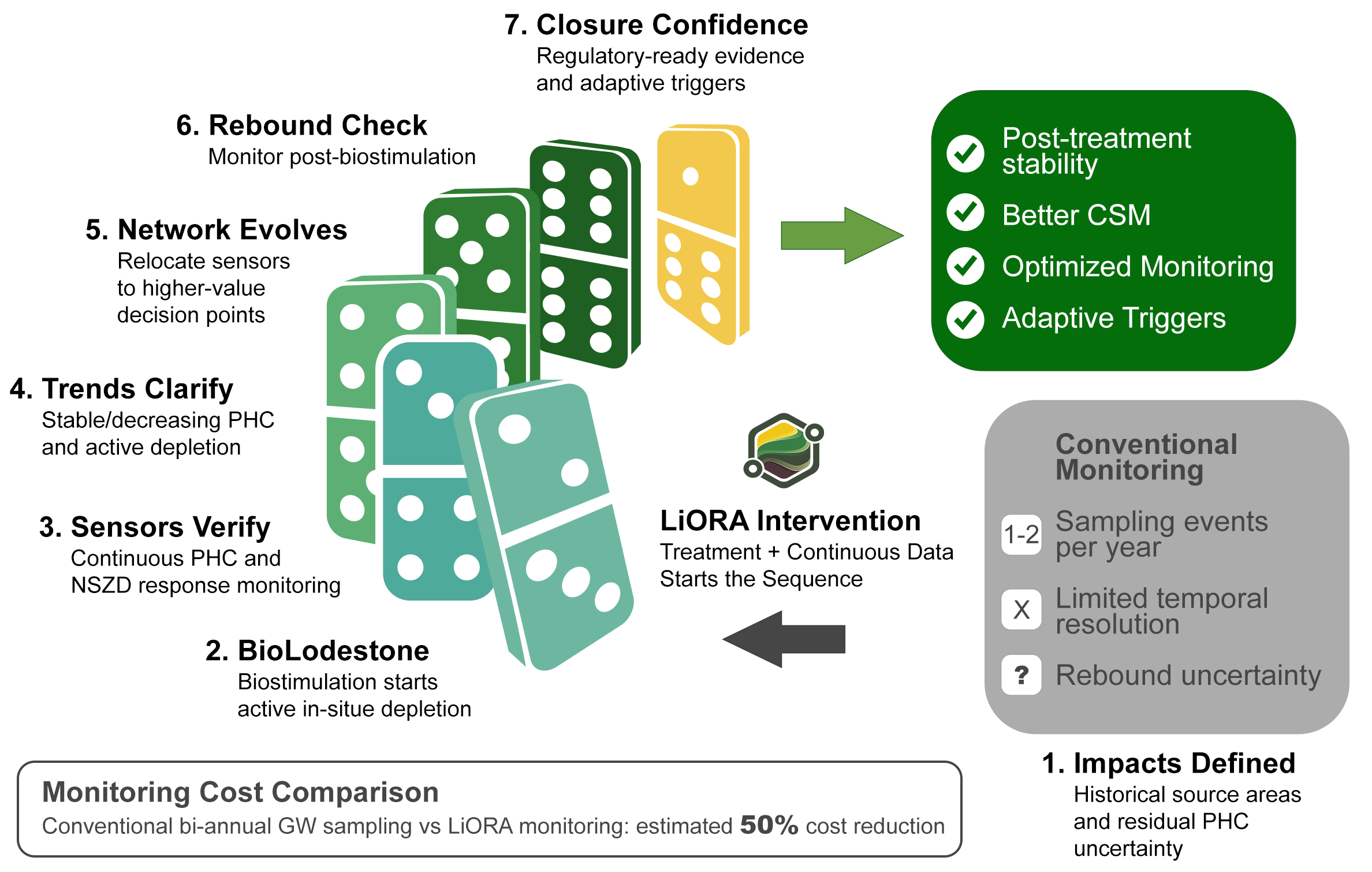
By pairing BioLodestone biostimulation with a continuous soil sensor network, we advanced a former Alberta bulk fuel site toward closure while collecting more than 175,000 data points over 20 months. The sensor record replaced conventional groundwater sampling as the primary monitoring evidence, confirming stable-to-declining PHC conditions and active depletion at roughly 50% lower annual cost than a twice-yearly sampling program.

Operational Savings in Remediation Phase
15 May 2026
Achieving $184,500 in operational savings was possible through SVE/MPE optimization and showcasing the average 14.9 kg/day depletion rate to the regulator with effective real-time monitoring.