
Managing Groundwater Fluctuations
May 13, 2026
This case study highlights our ability to effectively assess complex hydrocarbon plumes with 50-foot groundwater fluctuations at a multi-plume industrial site using 20 sensors and LiORA Insights to monitor and assess 3 distinct plumes.
Executive Summary
LiORA's comprehensive sensor network successfully characterized three distinct contamination plumes at varying depths within a large industrial facility that experiences extreme seasonal groundwater fluctuations of up to 50 feet. By deploying 20 water sensors across the complex site, LiORA provided critical insights into plume behavior under dynamic hydrogeological conditions, enabling reduced monitoring requirements while maintaining comprehensive site oversight.
Project Background
Site Complexity
A large industrial facility presented extraordinary environmental monitoring challenges:
- Extreme Groundwater Fluctuations: Seasonal water table variations of 50 feet created dynamic subsurface conditions
- Multi-Plume Contamination: Three distinct petroleum hydrocarbon plumes at different depths required individual assessment
- Large Scale Operations: Facility size demanded extensive monitoring coverage to capture spatial variations
Assessment Challenges
Traditional monitoring approaches faced significant limitations. In this instance, quarterly sampling was inadequate for capturing 50-foot groundwater swings, and the Site characteristics, including multiple plume depths, required complex well networks. The Consultant found that seasonal variations were potentially masking or amplifying contamination trends, and the large Site footprint required extensive spatial coverage.
LiORA Solution Implementation
Comprehensive Sensor Network
LiORA deployed an extensive monitoring system designed to address site complexity:
- Multi-Depth Coverage: Twenty water sensors strategically positioned to monitor three distinct plume depths across the facility.
- Plume-Specific Design: Each plume is treated as an independent monitoring zone with dedicated sensor arrays.
- Spatial Distribution: Sensors positioned to capture contamination variations across the large facility footprint.
Integrated Monitoring Strategy
The sensor network provided comprehensive site characterization including continuous PHC concentration monitoring across all three plumes, real-time tracking of extreme groundwater level fluctuations, correlation analysis between groundwater flux and contamination behavior and individual plume behavior assessment under dynamic conditions.
Key Findings and Results
Groundwater Fluctuation
LiORA's monitoring revealed how 50-foot water table swings affected contamination:
- Plume Behavior Differentiation: Each plume responded differently to extreme groundwater fluctuations, validating the need for individual assessment approaches.
- Seasonal Correlation Patterns: Continuous monitoring identified unique relationships between groundwater flux and PHC concentrations for each plume.
- Dynamic Risk Assessment: Real-time data enabled assessment of contamination behavior under extreme hydrogeological conditions.
Multi-Plume Management
Comprehensive monitoring provided insights into complex plume interactions:
- Independent Plume Tracking: Separate monitoring of each plume revealed distinct contamination patterns and seasonal responses.
- Depth-Specific Behavior: Different plume depths showed varying sensitivity to groundwater fluctuations.
- Facility-Wide Understanding: Extensive sensor coverage provided comprehensive picture of contamination across the large facility.
Operational Benefits
Monitoring Optimization
LiORA's approach significantly reduced traditional monitoring requirements:
- Reduced Field Sampling: Continuous monitoring eliminated need for frequent manual sampling across the large facility.
- Real-Time Intelligence: Immediate data availability replaced waiting periods between quarterly sampling events.
- Cost Efficiency: Sensor-based monitoring reduced labor and analytical costs associated with traditional approaches.
Enhanced Site Management
Comprehensive data coverage improved facility environmental management:
- Proactive Decision Making: Real-time data enabled immediate response to changing conditions.
- Regulatory Confidence: Continuous monitoring provided robust data for regulatory reporting and compliance.
- Operational Planning: Understanding of seasonal patterns supported facility operational planning.
Technical Innovation
Groundwater Fluctuations
Sensor network designed to handle challenging site conditions:
- Dynamic Range Capability: Sensors capable of continuous operation through 50-foot groundwater fluctuations.
- Multi-Depth Performance: Reliable monitoring across varying plume depths and groundwater conditions.
- Long-Term Stability: Consistent performance under extreme seasonal variations.
Multi-Plume Visualization
LiORA's platform provided sophisticated data analysis capabilities:
- Plume-Specific Trending: Individual visualization of each plume's seasonal behavior patterns.
- Correlation Analysis: Advanced analytics revealing relationships between groundwater flux and contamination for each plume.
- Integrated Dashboard: Comprehensive view of facility-wide contamination under extreme groundwater conditions.
Strategic Impact
Facility Management
Enhanced environmental oversight across large industrial operations:
- Comprehensive Coverage: Twenty sensors provided facility-wide contamination intelligence.
- Operational Integration: Monitoring data integrated with facility operations and maintenance planning.
- Risk Management: Continuous monitoring enabled proactive environmental risk management.
Regulatory Success
Robust monitoring approach met complex regulatory requirements:
- Multi-Plume Compliance: Demonstrated compliance across three distinct contamination areas.
- Continuous Reporting: Real-time data supported transparent regulatory communication.
- Adaptive Management: Dynamic monitoring enabled responsive environmental management.
Lessons Learned
Large facilities with multiple plumes and extreme groundwater fluctuations require extensive sensor networks to provide adequate spatial and temporal coverage.
Different plumes at varying depths respond uniquely to groundwater fluctuations, validating the need for individual assessment and monitoring strategies.
Comprehensive sensor networks can significantly reduce traditional monitoring requirements while providing superior data quality and temporal resolution.
Future Applications
The successful approach can also be applied to other large industrial facilities with complex contamination and extreme groundwater conditions.
Future deployments can incorporate additional parameters to provide an even more comprehensive understanding of contamination behavior under extreme conditions.
Project success supports broader adoption of sensor-based monitoring for complex industrial sites with challenging environmental conditions.
Conclusion
LiORA's deployment of 20 water sensors at this complex industrial facility successfully addressed the extraordinary challenges of monitoring three distinct plumes under extreme fluctuations in groundwater levels. By treating each plume as an independent monitoring zone, LiORA provided the comprehensive data necessary to understand contamination behavior under dynamic conditions while significantly reducing traditional monitoring requirements.
The project demonstrated LiORA's capability to handle the most challenging environmental monitoring scenarios, providing facility managers and regulators with the continuous intelligence necessary for effective environmental management of large, complex industrial operations.
Team Leads

Steven Siciliano
As CEO of LiORA, Dr. Steven Siciliano brings his experience as one of the world’s foremost soil scientists to the task of helping clients to efficiently achieve their remediation goals. Dr. Siciliano has made significant contributions to the progress of environmental and soil science with 11 book chapters and 220 scientific papers which have been cited over 17,000 times.
Discover More
The latest industry news, interviews, technologies, and resources.
Advancing Remediation Toward Closure
14 July 2026
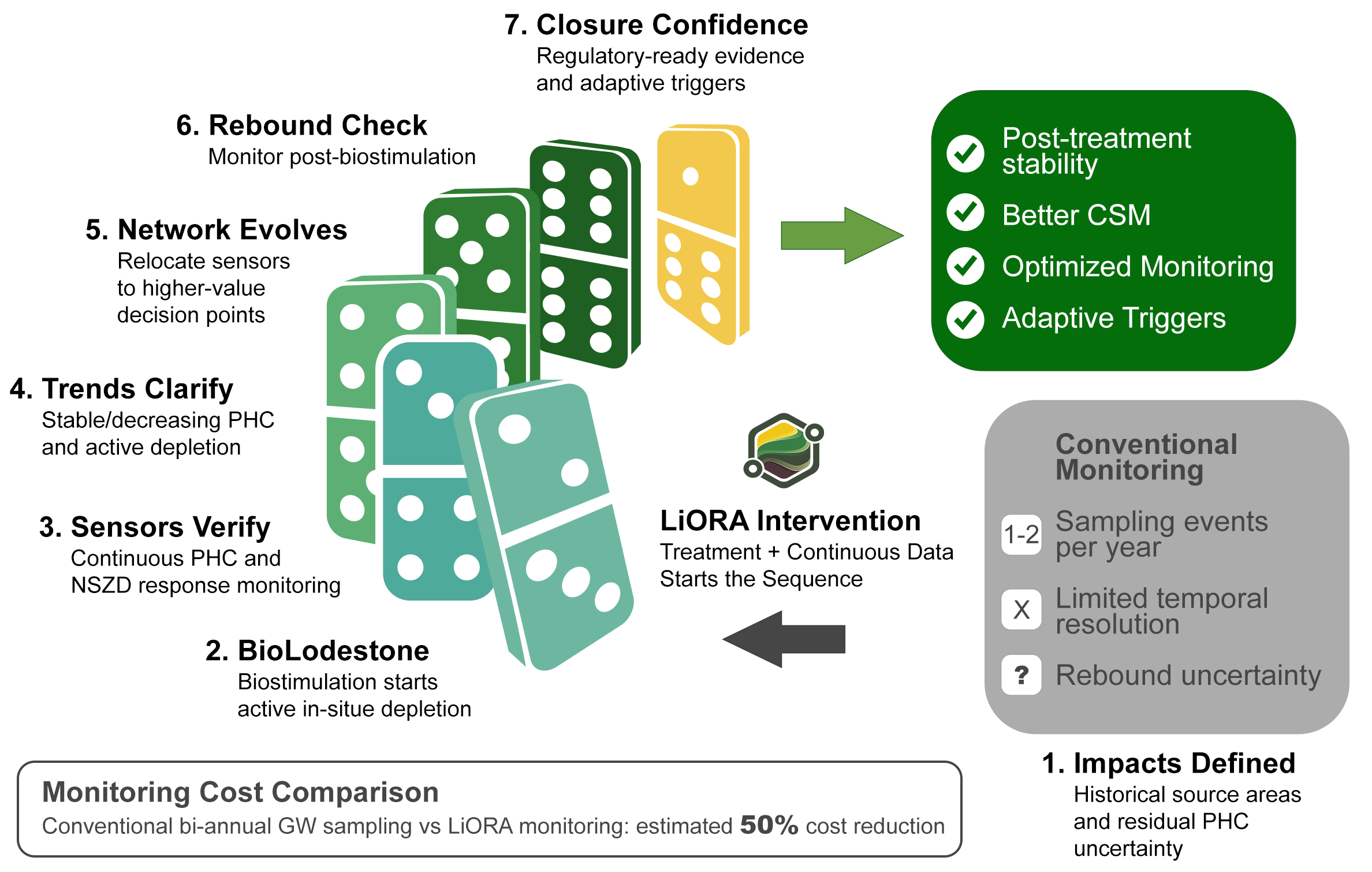
By pairing BioLodestone biostimulation with a continuous soil sensor network, we advanced a former Alberta bulk fuel site toward closure while collecting more than 175,000 data points over 20 months. The sensor record replaced conventional groundwater sampling as the primary monitoring evidence, confirming stable-to-declining PHC conditions and active depletion at roughly 50% lower annual cost than a twice-yearly sampling program.

Operational Savings in Remediation Phase
15 May 2026
Achieving $184,500 in operational savings was possible through SVE/MPE optimization and showcasing the average 14.9 kg/day depletion rate to the regulator with effective real-time monitoring.