
California Regulatory Approval for Risk Based Management
May 14, 2026
This significant milestone marks the first sensor-based monitoring approval known in California, enabling effective NSZD quantification using only three strategically deployed sensors for enhanced environmental protection.
Executive Summary
LiORA's sensor system for continuous monitoring of hydrocarbon depletion successfully supported regulatory approval for risk-based site management at a historical pipeline spill site in California. Through strategic deployment of soil sensors monitoring temperate, pressure, humidity, CO₂, CH₄, O₂, and hydrocarbon concentrations, LiORA provided real-time quantification of Natural Source Zone Depletion (NSZD) rates and plume stability data. This comprehensive dataset enabled presentation of a robust, data-driven case to California regulatory agencies, ultimately gaining state approval for sensor-based monitoring and risk-based site management approaches.
Project Background
Site Overview
A historical pipeline spill site in California required a comprehensive evaluation of natural attenuation processes and continuous monitoring to assess plume stability. The site's regulatory complexity demanded robust scientific evidence to support risk-based management decisions.
Regulatory Collaboration
The Consultant worked directly with LiORA and a California regulatory agency to establish monitoring protocols and demonstrate sensor technology capabilities for environmental assessment and ongoing site management.
Assessment Objectives
The project aimed to:
- Quantify Natural Source Zone Depletion rates through continuous monitoring;
- Assess plume stability in downgradient areas;
- Support risk-based management approach with robust scientific data; and
- Gain regulatory acceptance for sensor-based monitoring technology.
LiORA Solution
Strategic Sensor Deployment
LiORA installed 3 soil sensors strategically positioned to monitor critical site parameters:
- Multi-Parameter Monitoring: Sensors continuously logged CO₂, CH₄, O₂, and VOC concentrations within the hydrocarbon oxidation zone above the groundwater table.• Source Zone Coverage: Sensors placed to monitor NSZD processes in contaminated source areas.
- Downgradient Assessment: Monitoring network designed to assess plume stability and migration potential.
Comprehensive Data Collection
The monitoring system provided continuous assessment of natural attenuation processes, real-time NSZD rate quantification, plume stability assessment, natural attenuation effectiveness evaluation and provided an early warning system for contamination changes.
Key Results
NSZD Rate Quantification
LiORA's monitoring system provided precise measurement of natural attenuation:
- Real-Time Depletion Rates: Continuous monitoring enabled accurate quantification of NSZD processes occurring at the site.
- Scientific Validation: Multi-parameter monitoring provided robust scientific evidence of natural attenuation effectiveness.
- Temporal Resolution: Continuous data collection captured variations in NSZD rates over time, providing a comprehensive understanding of natural processes.
Plume Stability Assessment
Comprehensive monitoring demonstrated site stability:
- Migration Monitoring: Downgradient sensors provided continuous assessment of plume migration potential.
- Early Detection: Real-time monitoring enabled immediate detection of any changes in contaminant behavior.
- Stability Confirmation: Long-term monitoring data demonstrated plume stability and natural attenuation effectiveness.
Regulatory Success
State Agency Approval
LiORA's collaborative approach achieved significant regulatory milestones:
- Technology Acceptance: California regulatory agencies approved LiORA sensor technology for environmental monitoring applications.
- Risk-Based Management: Comprehensive monitoring data supported approval for risk-based site management approach.
- Precedent Setting: Successful collaboration established template for sensor-based monitoring in California regulatory framework.
Data-Driven Decision Making
Robust monitoring data enabled confident regulatory decisions:
- Scientific Evidence: Multi-parameter monitoring provided compelling scientific evidence for natural attenuation effectiveness.
- Risk Assessment: Continuous monitoring data supported comprehensive risk assessment and management decisions.
- Regulatory Confidence: Real-time data provided agencies with confidence in site management approaches.
Technical Innovation
Multi-Parameter Monitoring
LiORA's comprehensive monitoring approach provided superior site intelligence:
- Hydrocarbon Oxidation Zone: Targeted monitoring of the critical zone above the groundwater table where natural attenuation processes occur.
- Process Understanding: Multi-parameter monitoring enhanced understanding of natural attenuation mechanisms.
- Quality Assurance: Continuous monitoring provided high-quality data for regulatory decision-making.
Real-Time Analytics
Advanced data processing transformed monitoring data into actionable insights:
- NSZD Calculations: Real-time processing of multi-parameter data enabled immediate NSZD rate calculations.
- Trend Analysis: Continuous monitoring revealed temporal patterns in natural attenuation processes.
- Predictive Capability: Historical data supported predictions of future site behavior under natural attenuation.
Strategic Impact
Regulatory Framework Development
The project will contribute to regulatory framework evolution:
- Best Practice Integration: Successful implementation will inform regulatory best practices for sensor-based monitoring.
- Technology Standards: Collaboration to establish standards for continuous monitoring in environmental applications.
- Risk-Based Approaches: Project success to support broader adoption of risk-based management approaches.
Market Validation
Regulatory approval provided significant market validation:
- Technology Credibility: State agency approval established LiORA technology credibility.
- Competitive Advantage: Regulatory acceptance provided competitive advantage in California market.
- Replication Potential: Successful approach created template for similar regulatory collaborations.
Benefits and Value
Enhanced Site Management
Continuous monitoring provided superior site management capabilities:
- Proactive Approach: Real-time monitoring enabled proactive response to changing site conditions.
- Cost Optimization: Risk-based management approach optimized resource allocation.
- Regulatory Compliance: Continuous monitoring exceeded regulatory requirements for site oversight.
Scientific Advancement
The project advanced understanding of natural attenuation processes:
- Process Quantification: Precise measurement of NSZD rates enhanced scientific understanding.
- Temporal Resolution: Continuous monitoring provided unprecedented temporal resolution of natural processes.
- Validation Methods: Multi-parameter monitoring validated natural attenuation assessment methods.
Lessons Learned
Early and ongoing collaboration with regulatory agencies proved essential for successful technology adoption and risk-based management approval.
High-quality, continuous monitoring data provides the scientific foundation necessary for regulatory confidence in risk-based management decisions.
Comprehensive monitoring of multiple parameters enhances understanding of natural attenuation processes and provides more robust evidence for regulatory decisions.
Future Applications
Successful regulatory approval opens opportunities for broader deployment across California contaminated sites.
The collaborative approach provides template for similar regulatory partnerships in other jurisdictions.
Ongoing development will enhance sensor capabilities and expand monitoring parameters to provide even more comprehensive site assessments.
Conclusion
LiORA's successful collaboration with California regulatory agencies demonstrates the effectiveness of continuous monitoring in supporting risk-based site management decisions. Through the strategic deployment of multi-parameter soil sensors, LiORA provided the robust scientific evidence necessary to quantify NSZD rates and assess plume stability.
The project's success in gaining state approval for sensor-based monitoring and risk-based management approaches establishes LiORA as a leader in regulatory collaboration and technology acceptance. The comprehensive dataset generated through continuous monitoring provided regulators with the confidence necessary to approve innovative site management approaches.
This case study validates LiORA's approach to building data-driven cases for risk-based site management, demonstrating how continuous monitoring can transform regulatory decision-making from an assumption-based to an evidence-based approach.
Team Leads

Steven Siciliano
As CEO of LiORA, Dr. Steven Siciliano brings his experience as one of the world’s foremost soil scientists to the task of helping clients to efficiently achieve their remediation goals. Dr. Siciliano has made significant contributions to the progress of environmental and soil science with 11 book chapters and 220 scientific papers which have been cited over 17,000 times.
Discover More
The latest industry news, interviews, technologies, and resources.
Advancing Remediation Toward Closure
14 July 2026
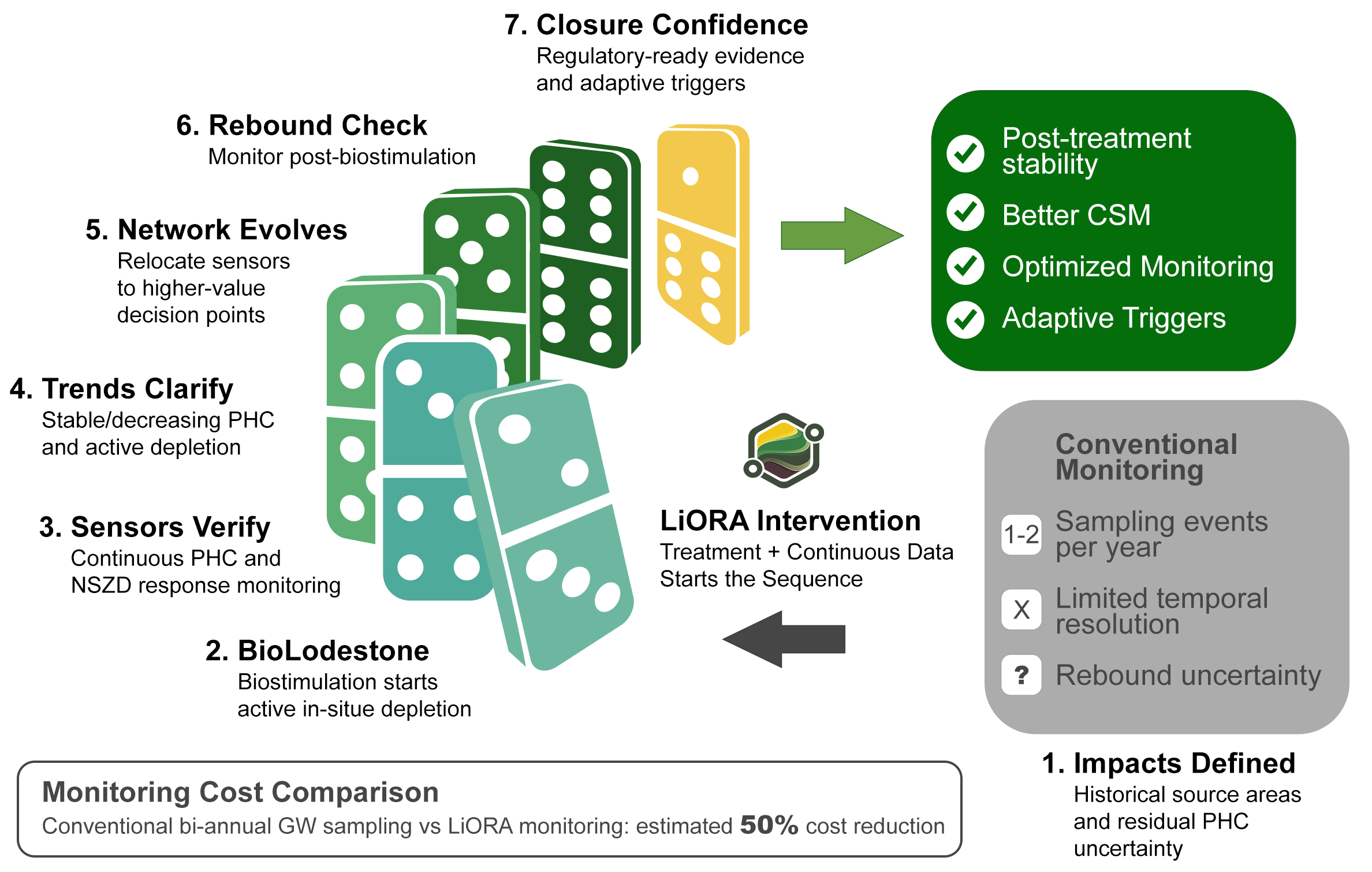
By pairing BioLodestone biostimulation with a continuous soil sensor network, we advanced a former Alberta bulk fuel site toward closure while collecting more than 175,000 data points over 20 months. The sensor record replaced conventional groundwater sampling as the primary monitoring evidence, confirming stable-to-declining PHC conditions and active depletion at roughly 50% lower annual cost than a twice-yearly sampling program.

Operational Savings in Remediation Phase
15 May 2026
Achieving $184,500 in operational savings was possible through SVE/MPE optimization and showcasing the average 14.9 kg/day depletion rate to the regulator with effective real-time monitoring.