
Accelerating Site Closure
May 13, 2026
This case study highlights significant savings from risk-based closure strategies, achieving $400,000 in sampling costs with the deployment of 16 sensors + LiORA Insights over just two years.

Executive Summary
LiORA's comprehensive sensor monitoring system successfully enabled risk-based closure at a longstanding hydrocarbon-contaminated commercial site, demonstrating how continuous data collection can accelerate regulatory approval processes. Through the strategic deployment of soil and water sensors, LiORA provided definitive evidence of plume stability and natural source zone depletion, transforming a decades-old contamination challenge into a regulatory success story that established a new standard for site closure validation.
Project Background
A small commercial lot had carried the burden of historical hydrocarbon contamination for decades, representing a common challenge in urban redevelopment. The site's compact footprint and commercial setting required careful risk assessment to determine appropriate closure pathways while maintaining regulatory compliance and protecting public health.
Regulatory Context
State regulators required comprehensive evidence to support risk-based closure decisions, including:
- Demonstration of minimal risk from soil vapour and groundwater exposure;
- Proof of groundwater contaminant plume stability over time;
- Quantification of Natural Source Zone Depletion (NSZD) rates; and
- Validation that natural attenuation was occurring at acceptable rates.
The Challenge
Traditional monitoring approaches would have required years of periodic sampling to establish the temporal trends necessary for risk-based closure approval. The site stakeholders needed to balance thorough risk assessment with timely closure to enable productive land use, while meeting stringent regulatory requirements for data quality and temporal coverage.
LiORA Solution
Comprehensive Sensor Network
LiORA deployed a sophisticated monitoring system across the commercial lot:
- Soil Monitoring Array: Ten (10) strategically positioned soil sensors provided comprehensive coverage of the vadose zone, monitoring soil vapor conditions and subsurface parameters critical to risk assessment.
- Groundwater Monitoring Network: Six (6) water sensors created a robust groundwater monitoring network, tracking contamination levels and plume behavior throughout the saturated zone.
Strategic Sensor Placement
The sensor network was designed to capture spatial variations in contamination across the site, monitor potential exposure pathways for risk assessment, track contaminant plume boundaries and migration patterns, and quantify natural attenuation processes in both soil and groundwater.
Long-Term Monitoring Campaign
A comprehensive two-year monitoring period via LiORA Insights ensured capture of:
- Seasonal variations in contaminant behavior;
- Long-term trends in contamination levels;
- Temporal stability of the contaminant plume; and
- Quantitative evidence of natural attenuation rates.
Regulatory Collaboration
State Regulator Partnership
LiORA worked closely with state environmental regulators throughout the project to establish clear monitoring objectives aligned with closure requirements, data quality standards meeting regulatory expectations, regular reporting protocols, stakeholder communication, and collaborative review processes for data interpretation.
Regulatory Acceptance Framework
The project established precedent for sensor-based monitoring in regulatory decision-making, demonstrating equivalence to traditional monitoring methods, enhanced data quality through continuous measurement, improved statistical confidence in temporal trends and accelerated timeline for regulatory review processes.
Key Findings and Results
Risk Assessment Validation
LiORA's continuous monitoring data via LiORA Insights provided definitive evidence that:
- Soil Vapor Risk Eliminated: Comprehensive soil sensor data demonstrated that soil vapor concentrations posed no significant risk to human health or environmental receptors.
- Groundwater Risk Minimized: Water sensor monitoring confirmed that groundwater contamination levels were stable and posed minimal risk under current and projected future land uses.
Plume Stability Demonstration
The two-year monitoring campaign conclusively showed:
- Contaminant plume boundaries remained stable over time;
- No evidence of plume migration or expansion;
- Consistent contamination patterns across monitoring periods; and
- Predictable seasonal variations within acceptable ranges.
Natural Source Zone Depletion Quantification
LiORA's data provided robust evidence of active NSZD processes:
- Measurable decline in contaminant concentrations over time;
- Quantifiable natural attenuation rates;
- Evidence of biodegradation and natural weathering processes; and
- Validation of long-term site stability under natural conditions.
Data Validation and Accuracy
Traditional Method Correlation
LiORA's sensor data showed excellent alignment with traditional monitoring approaches:
- Soil Vapor Concordance: Sensor measurements correlated closely with conventional soil vapor surveys, validating the accuracy of continuous monitoring data.
- NSZD Rate Confirmation: LiORA's calculated NSZD rates aligned with established assessment methodologies, providing independent verification of natural attenuation processes.
- Quality Assurance: The consistency between sensor data and traditional methods demonstrated the reliability and accuracy of LiORA's monitoring technology.
Statistical Robustness
Continuous monitoring provided superior statistical confidence compared to periodic sampling. LiORA provided thousands of data points versus dozens from traditional methods. The LiORA sensors eliminate temporal sampling bias while provided the enhanced ability to detect subtle trends and improved characterization of natural variability.
Regulatory Success
Risk-Based Closure Achievement
The comprehensive monitoring data enabled successful risk-based closure:
- Regulatory Approval: State regulators accepted LiORA's monitoring data as sufficient evidence for closure decisions, marking a significant milestone in sensor-based environmental assessment.
- Accelerated Timeline: The project achieved closure approval in a fraction of the time typically required for traditional monitoring approaches.
- Precedent Establishment: The successful closure created a template for future sensor-ased monitoring programs in the regulatory jurisdiction.
Stakeholder Satisfaction
Multiple project stakeholders recognized the value of LiORA's approach. The Regulator appreciated the comprehensive data coverage and statistical confidence. Consultants valued the accelerated timeline and reduced field work requirements. The Property owners benefited from faster closure and reduced long-term liability.
Industry Impact and Adoption
Regulatory Momentum
The project's success catalyzed broader adoption of sensor-based monitoring:
- Portfolio Expansion: Both regulatory agencies and consulting teams initiated reviews of additional sites for potential sensor deployment, recognizing the efficiency gains and improved data quality.
- Standardization Development: The project contributed to emerging guidance documents and best practices for continuous monitoring in environmental assessment.
- Regulatory Framework Evolution: State regulators began incorporating sensor-based monitoring options into formal guidance and approval processes.
Consulting Industry Transformation
Environmental consulting firms recognized the competitive advantages of sensor-based monitoring including reduced field sampling costs, simpler logistics, enhanced client satisfaction through faster project completion, improved technical quality, defensibility in assessments, new service offerings and revenue opportunities.
Technical Innovation Highlights
Advanced Sensor Technology
LiORA's monitoring system demonstrated several technical advantages:
- Continuous Operation: 24/7 monitoring capability provided unprecedented temporal resolution compared to traditional quarterly or annual sampling.
- Multi-Parameter Monitoring: Simultaneous measurement of multiple environmental parameters enhanced understanding of site conditions and natural processes.
- Remote Data Access: Real-time data transmission enabled continuous project oversight and rapid response to changing conditions.
- Long-Term Reliability: Two years of continuous operation validated sensor durability and measurement stability under field conditions.
Data Analytics Platform
Sophisticated data analysis capabilities transformed raw sensor measurements into actionable insights. This included advanced statistical analysis of contamination trends, automated anomaly detection, predictive modeling of future site conditions and integration with traditional assessment data/methods.
Economic Benefits
Cost-Effectiveness Analysis
LiORA's approach delivered significant economic advantages:
- Reduced Sampling Costs: Elimination of quarterly groundwater sampling and periodic soil vapor surveys resulted in substantial cost savings.
- Accelerated Timeline: Faster closure reduced carrying costs and enabled productive land use sooner.
- Reduced Liability: Comprehensive monitoring data provided enhanced protection against future environmental claims.
- Regulatory Efficiency: Streamlined approval processes reduced administrative costs and consultant time.
Return on Investment
The sensor deployment demonstrated strong ROI through offering a reduction in total project costs compared to traditional approaches, enhanced data quality, accelerated timeline benefits, regulatory confidence, and reduced long-term monitoring requirements. Without the density of the data this project would have been up to a decade away from moving to Site Closure offering approximately $400,000 of sampling cost reduction over that time period.
Lessons Learned
Regulatory Engagement
Early and ongoing collaboration with regulatory agencies proved crucial for project success. Clear communication about monitoring objectives, data quality standards, and interpretation methods facilitated regulatory acceptance.
Technology Integration
Successful implementation required careful integration of sensor technology with traditional assessment methods. LiORA's approach complemented rather than replaced conventional techniques, creating enhanced understanding of site conditions.
Data Management
Effective management of large continuous datasets required sophisticated data processing and visualization capabilities. LiORA's platform successfully transformed raw sensor data into meaningful insights for regulatory decision-making.
Future Applications and Scalability
Portfolio Expansion
The project's success has initiated broader adoption across multiple sites. The Regulatory agencies are evaluating sensor deployment at additional contaminated sites, with the Consulting firms incorporating sensor-based monitoring into standard practice and the property owners seeking to continue to achieve faster closure timelines for contaminated properties.
Technology Evolution
Ongoing development promises expanded capabilities including enhanced sensor sensitivity, more extensive parameter range, advanced predictive analytics, machine learning capabilities, integration with emerging remediation technologies and expanded regulatory acceptance frameworks.
Conclusion
LiORA's successful achievement of risk-based closure at this longstanding hydrocarbon contaminated site demonstrates the transformative potential of continuous environmental monitoring. By providing comprehensive, accurate, and timely data on soil vapor risk, groundwater conditions, and natural attenuation processes, LiORA enabled regulatory approval in a fraction of the time typically required.
The project's success validates LiORA's vision of data-driven environmental management and establishes new standards for site closure validation. The excellent correlation between sensor data and traditional methods confirms the accuracy and reliability of LiORA's monitoring technology, while the accelerated timeline and reduced costs demonstrate clear economic benefits.
Most importantly, this project has catalyzed broader adoption of sensor-based monitoring across the regulatory and consulting community. The expanding portfolio of sites under consideration for sensor deployment represents a significant market opportunity and validation of LiORA's technology platform.
This case study establishes LiORA as a leader in environmental monitoring innovation, demonstrating measurable value through accelerated site closure, reduced costs, and enhanced regulatory confidence. The project's success positions LiORA for continued growth as the environmental industry increasingly adopts continuous monitoring approaches for contaminated site management.
Team Leads

Steven Siciliano
As CEO of LiORA, Dr. Steven Siciliano brings his experience as one of the world’s foremost soil scientists to the task of helping clients to efficiently achieve their remediation goals. Dr. Siciliano has made significant contributions to the progress of environmental and soil science with 11 book chapters and 220 scientific papers which have been cited over 17,000 times.
Discover More
The latest industry news, interviews, technologies, and resources.
Advancing Remediation Toward Closure
14 July 2026
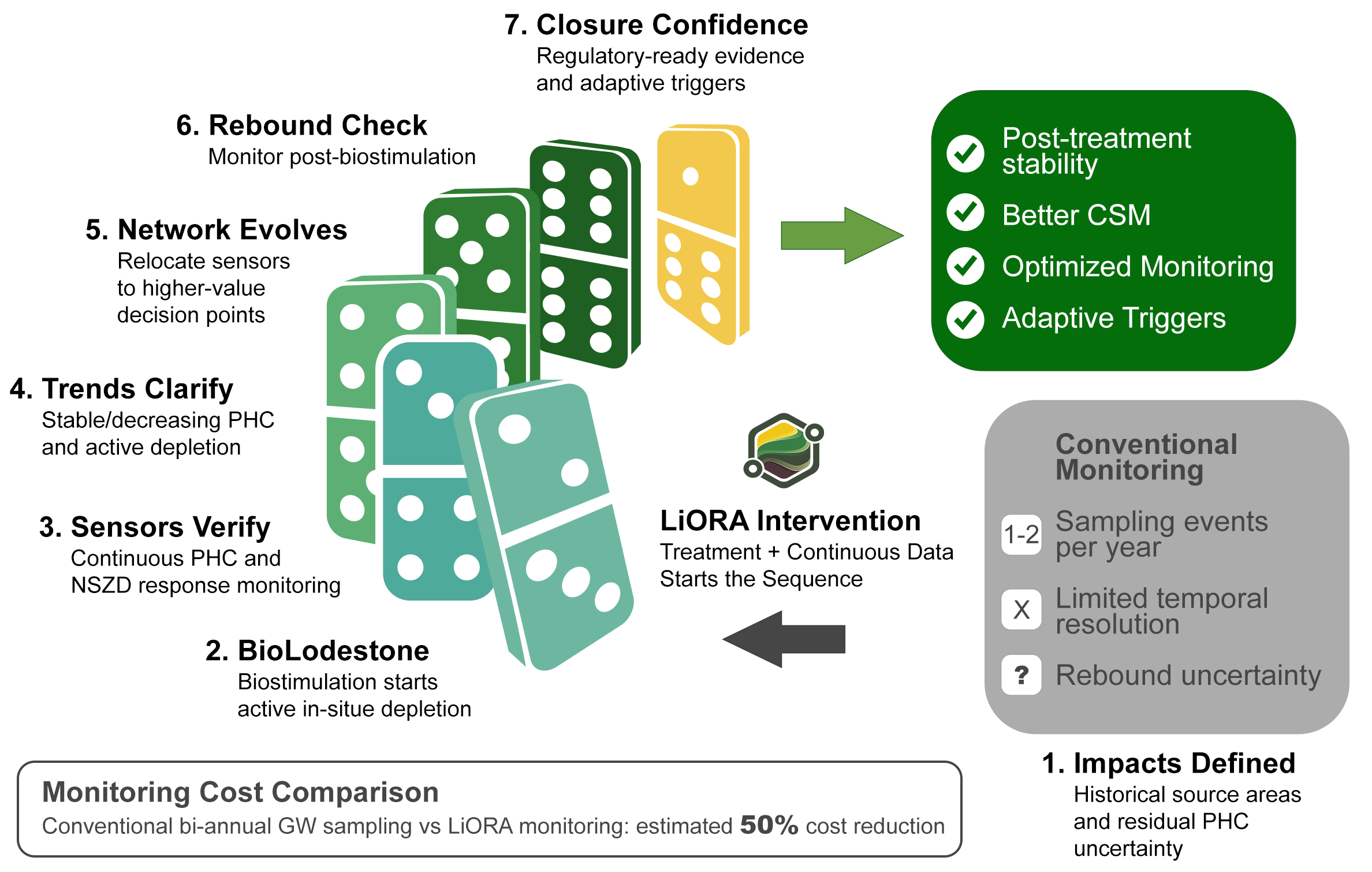
By pairing BioLodestone biostimulation with a continuous soil sensor network, we advanced a former Alberta bulk fuel site toward closure while collecting more than 175,000 data points over 20 months. The sensor record replaced conventional groundwater sampling as the primary monitoring evidence, confirming stable-to-declining PHC conditions and active depletion at roughly 50% lower annual cost than a twice-yearly sampling program.

Operational Savings in Remediation Phase
15 May 2026
Achieving $184,500 in operational savings was possible through SVE/MPE optimization and showcasing the average 14.9 kg/day depletion rate to the regulator with effective real-time monitoring.