Understanding Chloride Plume Migration
Introduction: Why Chloride Plumes Behave Differently
Chloride contamination presents a unique challenge in groundwater systems. Unlike many organic contaminants, chloride does not degrade, volatilize, or readily bind to soil. Once introduced into the subsurface, it moves with groundwater, often persisting for decades.
Understanding how chloride plumes migrate is critical for predicting environmental impact, designing monitoring programs, and making defensible remediation decisions.
This article explores the hydrogeological processes that control chloride plume movement: groundwater flow, subsurface heterogeneity, and seasonal dynamics.
Groundwater Flow: The Engine of Plume Migration
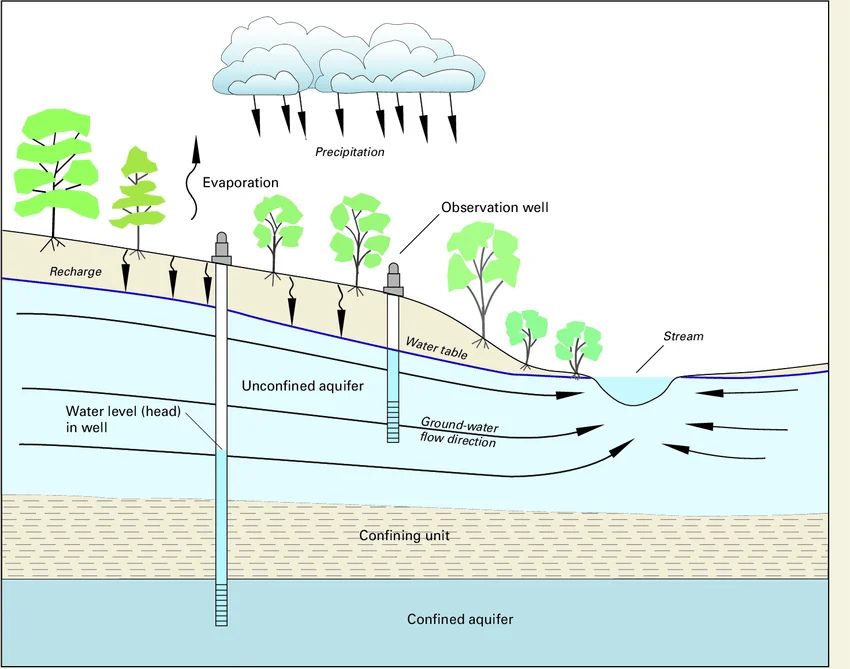
At its core, chloride plume migration is governed by groundwater flow.
Groundwater moves through aquifers following hydraulic gradients, from areas of higher hydraulic head to lower head. Chloride, being highly soluble and conservative, travels with this flow.
Key Concepts:
- Hydraulic Gradient: Determines direction and velocity of groundwater movement
- Darcy Velocity vs. Seepage Velocity: Actual plume movement is often faster than bulk flow estimates
- Flow Direction: Controls plume orientation and elongation
What This Means in Practice:
- Chloride plumes typically elongate in the direction of groundwater flow
- The leading edge of the plume advances over time, while the source area continues to contribute mass
- Small changes in gradient can significantly alter plume direction
Subsurface Heterogeneity: Why Plumes Don’t Move in Straight Lines
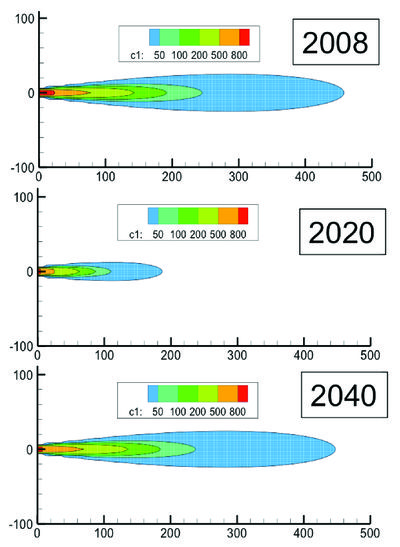
Real-world aquifers are rarely uniform. Variations in soil and rock properties, known as subsurface heterogeneity, have a major influence on plume behavior.
Key Factors:
- Permeability contrasts (e.g., sand vs. clay)
- Layering and stratigraphy
- Fractures and preferential pathways
Impact on Chloride Plumes:
- Plumes may spread unevenly, forming irregular shapes
- Faster pathways create fingering effects, where parts of the plume advance ahead
- Low-permeability zones can trap contamination, slowly releasing chloride over time
This complexity makes plume prediction difficult, and highlights the limitations of simplified models or sparse monitoring networks.
In heterogeneous systems, plume migration is not a single, uniform front. It is a dynamic, multi-path process influenced by both large-scale structure and small-scale variability.
Advection, Dispersion, and Diffusion: The Mechanics of Plume Transport
While groundwater flow defines the overall direction of plume movement, the shape and spread of a chloride plume are controlled by three primary transport mechanisms:
Advection
Advection is the transport of chloride with the bulk movement of groundwater.
- Governs the primary direction and velocity of plume migration
- Directly tied to seepage velocity and hydraulic gradient
- Dominates plume movement at larger scales
For chloride, which behaves conservatively, advection is the dominant transport process.
Mechanical Dispersion
Dispersion occurs because groundwater does not move uniformly through the subsurface.
- Water travels at different velocities through different pore spaces
- Results in spreading along (longitudinal) and across (transverse) the flow direction
Implications:
- Plumes elongate over time
- Concentration gradients become more gradual
- The leading edge becomes less defined
Molecular Diffusion
Diffusion is driven by concentration gradients, independent of bulk flow.
- Chloride moves from areas of high concentration to low concentration
- Particularly important in low-permeability zones
Implications:
- Sustains plume expansion even in stagnant zones
- Contributes to long-term persistence in clays and silts
Combined Effect: Plume Spreading
Together, these processes result in:
- Longitudinal spreading (along flow direction)
- Lateral spreading (perpendicular to flow)
- Vertical migration (especially in stratified systems)
The result is a plume that becomes increasingly diffuse over time, but often covers a larger area.
Source Characteristics and Mass Loading
The behavior of a chloride plume is not only controlled by the subsurface. It is also strongly influenced by the nature of the source.
Key Variables:
- Initial concentration
- Volume of release
- Duration of release (pulse vs. continuous source)
- Source location relative to the water table
Pulse vs. Continuous Sources
Pulse Release (e.g., single spill):
- Produces a plume that migrates and gradually attenuates through dispersion
- Source mass is finite
Continuous Release (e.g., ongoing leak):
- Sustains plume growth over time
- Can lead to stable or expanding plume fronts
Residual Mass and Secondary Sources
Even after the primary source is removed, chloride may remain in:
- Low-permeability zones
- Soil pore water above the water table
- Fractured rock matrices
These zones can act as secondary sources, slowly releasing chloride back into flowing groundwater, often referred to as back-diffusion.
Seasonal and Transient Flow Dynamics
Groundwater systems are subject to temporal variability, which introduces additional complexity to plume migration.
Recharge Events
- Snowmelt and precipitation increase hydraulic gradients
- Can accelerate plume migration
- May mobilize previously stagnant contamination
Water Table Fluctuations
- Rising water tables can inundate contaminated soils, introducing new chloride mass
- Falling water tables may isolate portions of the plume
Flow Direction Variability
- Seasonal or operational changes (e.g., pumping) can shift flow direction
- Plumes may reorient or spread into new क्षेत्रों
Implications for Monitoring
- Plume position and concentration can vary significantly over time
- Single-point or infrequent sampling may misrepresent true conditions
Plume Architecture and Evolution
Over time, chloride plumes develop distinct spatial characteristics:
Core Zone
- Highest concentrations
- Typically aligned with primary flow pathways
Fringe Zones
- Lower concentrations due to dispersion and mixing
- Often extend laterally and vertically
Plume Evolution Trends
- Elongation in the direction of flow
- Increasing spatial footprint
- Decreasing peak concentrations (but not necessarily reduced total mass)
Because chloride does not degrade, mass is conserved, meaning it’s only redistributed, not eliminated.
Implications for Modeling and Prediction
Accurate prediction of chloride plume migration requires accounting for:
- Spatial variability in hydraulic conductivity
- Time-varying boundary conditions
- Source dynamics and residual mass
- Coupled transport processes (advection–dispersion–diffusion)
Limitations of Traditional Approaches
Simplified models often assume:
- Homogeneous aquifers
- Steady-state flow
- Limited spatial resolution
These assumptions can lead to:
- Underestimation of plume extent
- Mischaracterization of plume direction
- Poor alignment with observed data
Toward More Robust Understanding
Modern approaches incorporate:
- High-resolution site characterization
- Continuous monitoring data
- Numerical groundwater flow and transport modeling
- Data assimilation techniques
These methods improve the ability to:
- Forecast plume migration
- Quantify uncertainty
- Support defensible decision-making
Closing Insight: Chloride Moves Simply. Until It Doesn’t
At a chemical level, chloride is straightforward: it moves with water.
But groundwater systems are anything but simple.
Heterogeneity, transient flow, and transport processes combine to create plume behavior that is dynamic, non-linear, and highly site-specific.
Understanding these dynamics is essential, not just for describing plume movement, but for anticipating it.
LiORA integrates continuous chloride monitoring with predictive modeling to provide a dynamic view of plume behavior, helping you understand not just where contamination is, but where it’s going next.
Book a demo to learn how LiORA helps you move beyond snapshots and understand plume migration in real time.
Author

As CEO of LiORA, Dr. Steven Siciliano brings his experience as one of the world’s foremost soil scientists to the task of helping clients to efficiently achieve their remediation goals. Dr. Siciliano is passionate about developing and applying enhanced instrumentation for continuous site monitoring and systems that turn that data into actionable decisions for clients.