
Understanding Groundwater Contamination Dynamics
May 13, 2026
Achieving $49,500 in annual savings by transitioning from quarterly to annual sampling utilizing 6 sensors for enhanced groundwater dynamics correlation and reduced operational costs.
Executive Summary
LiORA's integrated monitoring system successfully characterized the relationship between seasonal groundwater fluctuations and petroleum hydrocarbon concentrations at a former gas station site, providing critical insights for risk assessment and regulatory decision-making. By combining continuous contamination monitoring with groundwater level tracking, LiORA delivered the comprehensive data necessary to understand plume behavior and demonstrate minimal risk to nearby residential areas.
Project Background
Site Overview
A former gas station site presented typical urban contamination challenges, with potential impacts from petroleum hydrocarbons threatening a nearby residential area. The site's location necessitated a careful assessment of contaminant migration patterns and risk characterization to protect community health and inform appropriate land use decisions.
Assessment Objectives
The project aimed to:
- Assess potential plume migration toward residential receptors;
- Establish risk levels for nearby residential areas;
- Understand the relationship between seasonal groundwater changes and contamination behavior; and
- Provide data-driven narrative connecting groundwater flux to PHC concentrations/
LiORA Solution
Monitoring System Design
LiORA deployed a targeted monitoring network to capture both contamination and hydrogeological dynamics:
- Water Quality Monitoring: Three water sensors strategically positioned to track petroleum hydrocarbon concentrations and potential migration pathways.
- Hydrogeological Monitoring: Three groundwater level loggers were placed to monitor seasonal water table fluctuations and groundwater flow patterns.
Integrated Data Collection
The combined monitoring approach provided comprehensive understanding of site conditions in terms of continuous PHC concentration measurements, real-time groundwater level tracking, synchronized data collection enabling direct correlation analysis and seasonal trend identification and pattern recognition.
Key Findings and Results
Seasonal Correlation Analysis
LiORA's continuous monitoring revealed clear relationships between groundwater dynamics and contamination behavior:
- Groundwater Flux Impact: Data demonstrated a direct correlation between seasonal groundwater level changes and PHC concentration fluctuations.
- Predictable Patterns: Monitoring identified consistent seasonal patterns in contamination behavior, enabling predictive assessment of future conditions.
- Migration Assessment: Continuous tracking provided definitive evidence regarding plume migration potential toward residential areas.
Risk Characterization
Comprehensive monitoring data enabled confident risk assessment:
- Residential Area Protection: Data confirmed minimal risk to nearby residential receptors under all seasonal conditions.
- Exposure Pathway Analysis: Continuous monitoring validated assumptions about contaminant transport and exposure pathways.
- Regulatory Confidence: Robust dataset supported regulatory decision-making with high statistical confidence.
Customer Cost Savings
Site owner reduced quarterly groundwater sampling to only annual.
Cost Mitigation (Per Site Per Year)
Reduced Site Mobilization = $45,000
Reduced Analytical Fees = $4,500
TOTAL AVERAGE ANNUAL SAVINGS = $49,500
Technical Innovation
Visualization and Trending
LiORA's data platform provided powerful analytical capabilities:
- Real-Time Visualization: Continuous data streams enabled immediate visualization of contamination and groundwater trends.
- Correlation Analysis: Advanced analytics identified relationships between groundwater flux and PHC concentrations.
- Seasonal Trending: Long-term data collection revealed seasonal patterns invisible to traditional sampling approaches.
- Predictive Modelling: Historical patterns enabled the projection of future contamination behavior under various seasonal conditions.
Impact and Benefits
Regulatory Success
The comprehensive monitoring approach delivered clear regulatory benefits:
- Data-Driven Decisions: Continuous monitoring provided robust foundation for risk-based decisions.
- Accelerated Assessment: Real-time data eliminated delays associated with traditional quarterly sampling.
- Enhanced Confidence: Comprehensive temporal coverage improved regulatory confidence in site assessment.
Community Protection
Monitoring results provided assurance of community safety:
- Risk Validation: Data confirmed minimal risk to residential areas under all seasonal conditions.
- Transparent Communication: Continuous monitoring enabled transparent communication with community stakeholders.
- Proactive Management: Real-time data supported proactive response to any changing conditions.
Scientific Understanding
The project enhanced understanding of contamination-hydrogeology interactions:
- Seasonal Dynamics: Detailed characterization of how seasonal changes affect contamination behavior.
- Predictive Capability: Established relationships enable prediction of contamination response to future seasonal cycles.
- Best Practice Development: Successful integration of contamination and hydrogeological monitoring established new assessment standards.
Lessons Learned
Integrated Monitoring Value
The project demonstrated that simultaneous monitoring of contamination and groundwater levels provides insights unavailable through traditional separate assessments.
Continuous Data Advantage
Real-time monitoring revealed seasonal patterns and correlations that would be missed by periodic sampling approaches.
Regulatory Acceptance
Comprehensive temporal data enhanced regulatory confidence and accelerated decision-making processes.
Future Applications
The successful approach is applicable to numerous similar sites with seasonal groundwater variations and contamination concerns.
Future deployments can incorporate additional parameters such as temperature, conductivity, and geochemical indicators to provide even more comprehensive site understanding.
The project's success supports broader adoption of continuous monitoring approaches in regulatory frameworks.
Conclusion
LiORA's integrated monitoring approach at this former gas station site successfully characterized the complex relationship between seasonal groundwater fluctuations and petroleum hydrocarbon concentrations. By providing continuous data on both contamination levels and hydrogeological conditions, LiORA delivered the comprehensive understanding necessary for confident risk assessment and regulatory decision-making.
The project demonstrated that continuous monitoring provides superior insights compared to traditional assessment approaches, particularly for understanding seasonal dynamics and temporal relationships. The successful correlation of groundwater flux with PHC concentrations provides a powerful tool for predicting contamination behavior and ensuring long-term protection of residential receptors.
This case study establishes LiORA's capability to deliver sophisticated environmental monitoring solutions that address complex site conditions while providing the data quality and temporal resolution necessary for regulatory success.
Team Leads

Steven Siciliano
As CEO of LiORA, Dr. Steven Siciliano brings his experience as one of the world’s foremost soil scientists to the task of helping clients to efficiently achieve their remediation goals. Dr. Siciliano has made significant contributions to the progress of environmental and soil science with 11 book chapters and 220 scientific papers which have been cited over 17,000 times.
Discover More
The latest industry news, interviews, technologies, and resources.
Advancing Remediation Toward Closure
14 July 2026
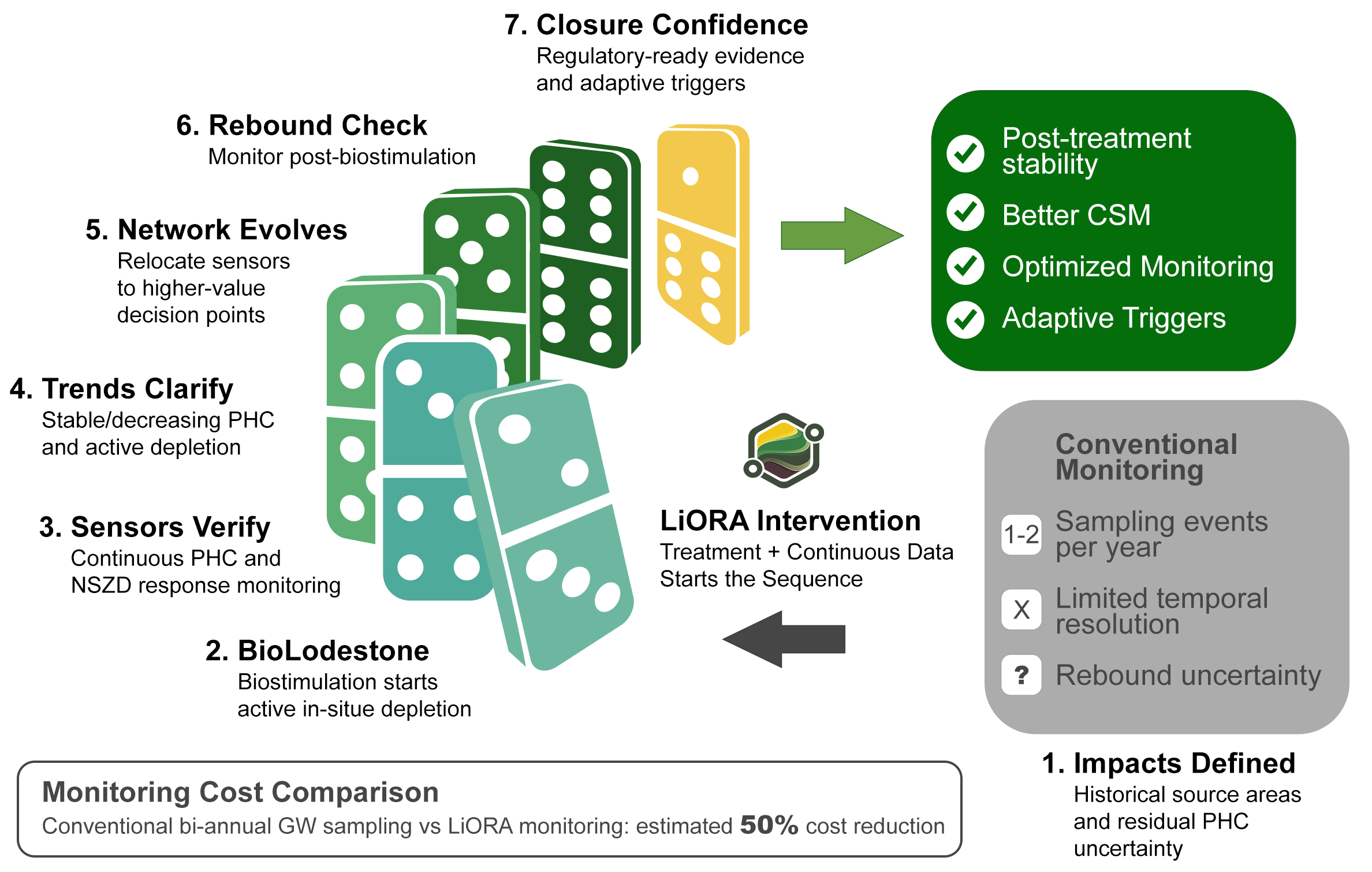
By pairing BioLodestone biostimulation with a continuous soil sensor network, we advanced a former Alberta bulk fuel site toward closure while collecting more than 175,000 data points over 20 months. The sensor record replaced conventional groundwater sampling as the primary monitoring evidence, confirming stable-to-declining PHC conditions and active depletion at roughly 50% lower annual cost than a twice-yearly sampling program.

Operational Savings in Remediation Phase
15 May 2026
Achieving $184,500 in operational savings was possible through SVE/MPE optimization and showcasing the average 14.9 kg/day depletion rate to the regulator with effective real-time monitoring.